

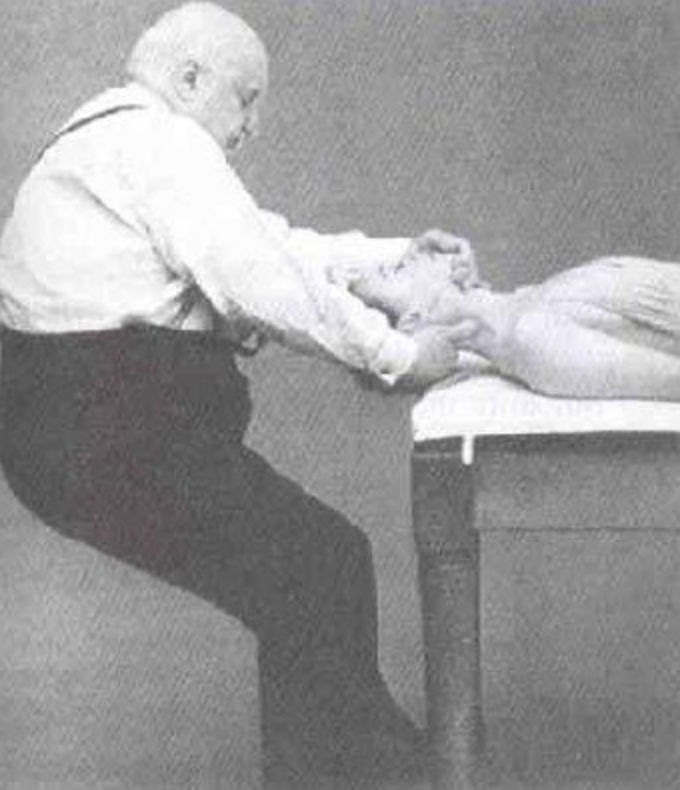
James Henry Cyriax was born in London in 1904 into a distinguished family of gymnastic directors — Swedish educated physiotherapists who combined physical education and manual therapy.
His maternal grandfather, Jonas Henrik Kellgren (1837–1916), was a renowned figure at the Royal Central Institute of Gymnastics (RCIG) in Stockholm. Kellgren had developed a manual therapy approach known internationally as “Kellgrenism,” which attracted patients from around the world. Anders Ottosson (2025) considers Kellgren the father of all manual therapy.
Cyriax’s paternal grandfather, Julius Friedrich Theodor Cyriax, was a German pharmacist who moved to England and became known for producing salicylates used to treat musculoskeletal disorders. He was also a patient of Kellgren, further intertwining the family’s connection to manual therapy.
His father, Edgar Ferdinand Cyriax (1874–1955), studied medical gymnastics at RCIG and authored several publications, including the influential 1903 book “The Elements of Kellgren’s Manual Treatment.” He worked alongside Dr. James Mennell at St Thomas Hospital in London and later earned a medical degree from the University of Edinburgh in 1898.
His mother, Annjuta Kellgren Cyriax (1875–1965), trained at the RCIG and worked in physical medicine at Oxford University. She advocated for collaboration between physiotherapists and surgeons and emphasised the need for scientific training in manual therapy techniques.
One of Cyriax’s sisters, Anna Violet Cyriax, also studied at RCIG and published research on menstruation and lumbar mobility, recommending stabilisation exercises over mobilisation during that time.
A cousin, Dr Jonas Kellgren (1911-2002) was England’s first professor of rheumatology, who developed a classification system of knee arthritis, expanded the understanding of referred pain and was a pioneer for the science of trigger points.
James, himself, studied medicine at Cambridge University and later at St. Thomas Hospital Medical School, graduating in 1929. In 1938, he earned his doctorate with a thesis on chronic elbow sprain, which later won the prestigious Heberden Prize in 1943.
He married twice: First to Leonora Rosina Anna Capello, Italy’s first female lawyer, with whom he had two children. Later to Patricia Jane McClintock, a physiotherapist who helped preserve and co-author his work, including the “Illustrated Manual of Orthopaedic Medicine.”
Historical Turning Points
In the early 20th century, Swedish orthopaedic surgeons sought to separate orthopaedic medicine from medical gymnastics. In 1913, Patrick Haglund became the first professor of orthopaedics at the Karolinska Institute and led reforms that split the RCIG’s training into two distinct professions: Physical Education and Physiotherapy. This shift placed physiotherapists under the authority of surgeons and removed RCIG’s role in physiotherapy education, effectively ending the Ling-Kellgren system (Ottosson, 2025).
During the 1920s and 1930s, American osteopaths arrived in England, seeking recognition as an independent profession. Cyriax criticised their political manoeuvring and feared they would co-opt the manual therapy legacy of his family. To protect this knowledge, he distanced himself from his gymnastic director roots – committing “historical patricide” (Ottosson, 2025), and instead aligned with Hippocrates by adopting the title “orthopaedic physician” (Tricás-Moreno, et al., 2013).
In 1938, Cyriax founded the first Department of Orthopaedic Medicine at St. Thomas Hospital, London, which included sections for electro-diagnosis and massage. He led the massage section, applying techniques inherited from his grandfather Kellgren and the RCIG without acknowledgement and thereby established the foundation for Orthopaedic Manual Therapy.
A New System
Cyriax was strongly influenced by his predecessor at St Thomas Hospital, Dr James Mennell, who emphasised the importance of differential diagnosis — particularly how thoracic symptoms could mimic visceral conditions. Mennell advocated for thorough clinical evaluation before applying spinal manipulation, a principle Cyriax adopted and expanded upon.
As an orthopaedic surgeon, Cyriax observed that many patients had musculoskeletal complaints that were not visible on X-rays. These “radiolucent” soft tissue dysfunctions created a diagnostic gap between symptoms and treatment. Cyriax (1947) said,
As an orthopaedic surgeon, I saw many patients whose X-rays revealed nothing, yet they were in pain. I realised there was no satisfactory method to evaluate the function of radiolucent soft tissues. That’s when I set out to develop such a system.”
Cyriax advocated for a logical, structured physical examination that considered both symptoms and clinical signs in relation to the function of specific anatomical structures (Glyn, 1985). He insisted that every session begin with a detailed patient interview to assess symptom changes, followed by a physical examination to detect any new signs.
Physiotherapy
While many physiotherapists today associate Cyriax primarily with his technique of deep transverse friction massage, his legacy extends far beyond isolated manual techniques. His most profound contribution was the promotion (or re-promotion) of physiotherapist clinical autonomy through his teaching of a structured, logical approach to physical diagnosis. Specifically, he believed that physiotherapists should not merely apply treatments but must first conduct a thorough physical diagnosis tailored to each patient’s unique anatomy and pain tolerance. More broadly, Cyriax (1970) went on to say,
In 1938, when I started teaching physiotherapists manual techniques, I found them most suited to performing manipulation. They know their anatomy well; they study movement in all its branches; they learn the function and the feel of joints and muscles; they develop strong, sensitive and skilful hands; they possess time and patience and are accustomed to working with doctors.”
Cyriax’s advocacy of physiotherapy through the teaching and resulting competence of physiotherapists who were willing to learn came at a price (Hutson, 1990). The intransigence of large sectors of the medical profession slowed the progress of orthopaedic medicine, particularly in respect of the establishment of its rightful place amongst other medical disciplines.
Conclusion
Despite initially distancing himself from his gymnastic director heritage and thereby helping subordinate physiotherapy under orthopaedic medicine, Cyriax’s contributions to the profession are ultimately invaluable. His work laid the foundation for:
- The development of Orthopaedic Manual Therapy as a specialty of physiotherapy
- The creation of diagnostic systems that empower physiotherapists to assess and treat patients independently.
- The professionalisation and scientific grounding of manual therapy techniques.
- The establishment of International Federation of Orthopaedic Manipulative Physical Therapists (IFOMPT) in 1974.
Cyriax’s vision ultimately transformed physiotherapy back into a profession grounded in clinical reasoning, autonomy, and scientific rigour. His influence continues to shape how physiotherapists are trained and how they practice worldwide.
References
Cyriax J. (1970). Manipulation by physiotherapists. Australian Journal of Physiotherapy, 16(1), 32-26.
Cyriax J. (1947). Textbook of orthopaedic medicine, Vol I: Diagnosis of soft tissue lesions. Balliere Tindall: London.
Glyn J. (1985). Obituary: James Cyriax. British Journal of Rheumatology, 24, 376-377.
Hutson MA. (1990). The Cyriax contribution to manipulation. In: Paterson JK & Burn L (eds), Back Pain. Springer: Dordrecht.
Ottosson A. (2025). The lost origins of osteopathy and chiropractic in European mechanical medicine and physical education, c. 1800-1950. Routledge.
Tricás-Moreno JM, Bueno-Gracia E, Jiménez-del Barrio S, Garcia-Santesteban O, Pérez-Guillén S and Fortún-Agud M. (2013). James Cyriax y la Fisioterapia. Monografia, Historia de la evolución de la Fisioterapia (1813-2013) [James Cyriax and Physiotherapy. Monograph, History of the Evolution of Physiotherapy (1813-2013)], 176-186. Translated by Microsoft Co-Pilot.
Response from Robert Jones
Thank you for publishing your fantastic piece on James Cyriax.Interestingly I regularly attended Professor Jonas Kellgren’s [James Cyriax’s cousin] back clinics at the Robert Jones and Agnes Hunt Hospital in Oswestry, Shropshire in the late 1970s as a senior physiotherapist to his clinic. At the time I was working as senior physiotherapist in manual therapy at the Royal Salop Infirmary in Shrewsbury. The clinic was set up to see patients from all over the UK who were referred from many hospitals for Kellgren’s opinion. Many of the patients had been through a wide range of interventions and procedures without success. Kellgren also had an eminent spinal surgeon attending the clinic to provide surgery for those patients requiring surgical intervention.Attendance at these clinics was a great privilege and an amazing learning experience particularly as at the time I was a supervisor for the Chartered Society of Physiotherapy validated manipulation courses for graduate physiotherapists. This course was a forerunner to the courses offered later in universities around the country The course prepared graduate physiotherapists for the MACP validated courses first set up by Greg Grieve (who I also worked under) when a student and when newly qualified in the early 1970s.Kellgren did much of the early research work on referred pain and was skilled in the use of hypertonic saline injections in the research process. Papers published by Kellgren were required reading in the demanding reading requirements for the examination leading to qualification for Membership of the MACP.I thought this little piece of personal background information might be of interest in the Cyriax and Cyriax allied context.
