

While undertaking research of original documents and books at the Wellcome Collection in London a few months ago I came across a first edition of the famous book by Margaret Dora Palmer titled ‘Lessons on Massage’, published in 1901.
In the opening lines of the book’s preface Palmer (1901) says,
“At the earnest and oft-repeated request of my pupils, I publish my lessons on massage, in the hope that they and others will find them as useful as they anticipate.”
Her hopes were well realised for the book was widely used in massage teaching in the UK, Europe and the then British Colonies. It was also transcribed into braille for the school for blind students at the National Institute for the Blind in Great Portland Street, London. The book was popular for several decades, being updated and re-edited many times and running into at least six editions. It continued to be a standard text well into the twentieth century.
‘Lessons on Massage’ opens with a very interesting chapter on the history and development of massage with an extensive overview of massage from ancient times until the time when the book was written. Not least we learn that the word ‘massage’ is derived from the Greek meaning ‘to knead’, and an Arabic word meaning ‘to press’, but it comes through the French,
There is a chapter each on the anatomy of the musculoskeletal, vascular and neurological systems, and chapters on the upper limb, lower limb, trunk, and head, face and neck. Further chapters cover specific body regions, spinal curvature, general massage and children. It is a fascinating volume covering detailed descriptions and thorough guidance on all aspects of massage.
I recall seeing notes on massage techniques derived from Margaret Palmer’s work when I was in physiotherapy training myself between 1968 and 1971. There were detailed descriptions for example on positioning, technique, purpose, physiological and therapeutic effects, and for example, effleurage, petrissage, chopping, clapping, tapotement, frictions, hacking, vibrations and many more. Undoubtedly Palmer’s work had a significant influence on the advancement and use of massage in the development and evolution of physiotherapy patient care and practice and also essentially in physiotherapy training and education as touch and handling are essential bedrocks of physiotherapy.
The Author
Margaret Palmer was born in 1837 and trained in nursing/midwifery at Endell Street, London. In 1881 she began to develop an interest in ‘medical rubbing’ (massage) and in 1891 was employed to manage the Massage Department at the London Hospital, Whitechapel, where she instructed the nursing staff there after completing travels to Europe and America to study massage methods. In 1892 she advertised her private massage school in the ‘Nursing Notes” publication (Wicksteed, 1948).
Palmer was considered an authority in ‘English massage’, and the fly page of her book proudly lists her accomplishments in upper case.
MASSEUSE AND MANAGER OF THE MASSAGE DEPARTMENT OF THE LONDON HOSPITAL
INSTRUCTOR OF MASSAGE TO THE NURSING STAFF OF THE LONDON HOSPITAL
MEMBER OF THE COUNCIL OF THE INCORPORATED SOCIETY OF TRAINED MASSEUSES
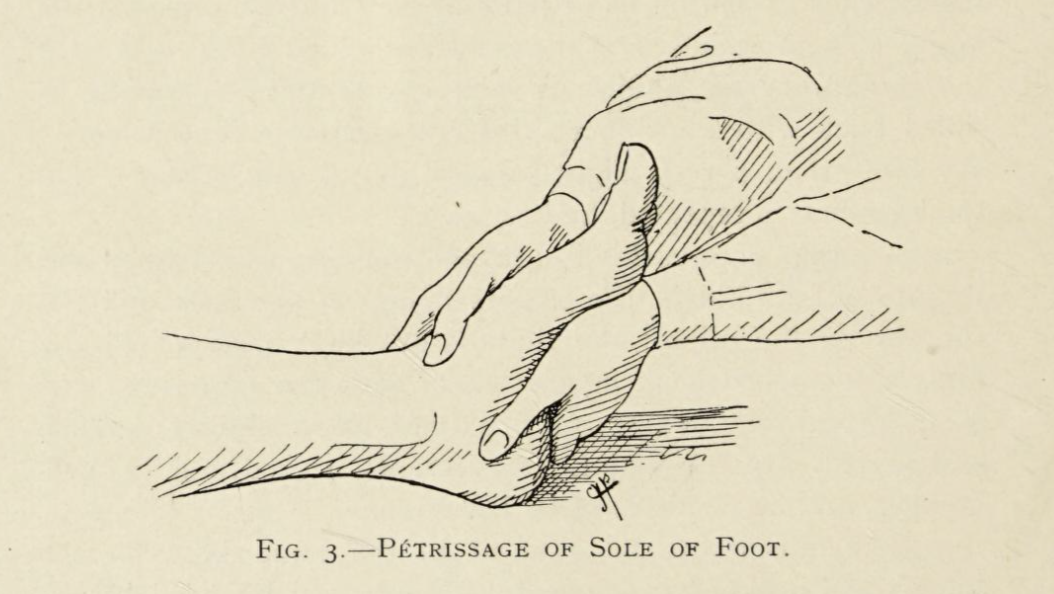
Palmer’s husband and son were both masseurs and her son, Jackson Palmer, provided many of the drawings in her books – see featured image above. She also compiled the section on massage in the Medical Encyclopaedia (King, 1961),
The Society of Trained Masseuses
In 1894 midwives and masseuses Lucy Robinson and Rosalind Paget were joined by Palmer and Elizabeth Manley to discuss the creation of a Massage Society. The first minuted meeting of the sub-committee of the Midwives Institute to consider “massage in all its bearings”, particularly regarding certification of competence, was Chaired by Rosalind Paget and the committee members included Margaret Palmer, Lucy Robinson, Elizabeth and Guilelma Manley (sisters) and Augusta Arthur as the Honorary Secretary.
These women were products of the highly varied training opportunities available for massage in the late-nineteenth century. Schooled in a range of massage traditions, leading members brought together an openness and flexibility towards expertise that characterised the early profession (Nias, 2017).
The list of topics covered by the proposed rules for the Society of Trained Masseuses (STM) included massage only to be administered under medical direction. No general massage undertaken for male patients (only exceptionally under the special request of a doctor for specific cases) and no advertising in any but strictly medical papers. Soon other rules and procedures were added such as, ‘No sale of drugs to patients allowed’.
Initially, the principle of sex segregation not only governed the practice of massage, but also the STM’s principles regarding training, examination and membership. However this rule proved difficult to implement in practice, and there are many examples of the Council making exceptions while continuing to hold steadfast to their Victorian conventions. For example, Palmer’s son Jackson was co-opted by the STM to be the first examiner of male Army masseurs (Wicksteed, 1948).
References
King H. (1961). Society of Trained masseuses Council Minutes, 2nd March 1906. Draft History of the CSP (typescript), p23.
Nias K. (2017). Negotiating intimacies: Gender, rehabilitation and professionalisation of massage in Britain, c.1880-1920. Thesis submitted to Exeter University. Accessed online at https://www.proquest.com/openview/63678b7244d4bbf945099a3fb34259e3/1?pq-origsite=gscholar&cbl=51922&diss=y on 26 February 2026.
Palmer, MD. (1901). Lessons on Massage. Balliére, Tindall and Cox: London.
Wicksteed, J. (1948). The growth of a profession. Edward Arnold & Co: London.
