

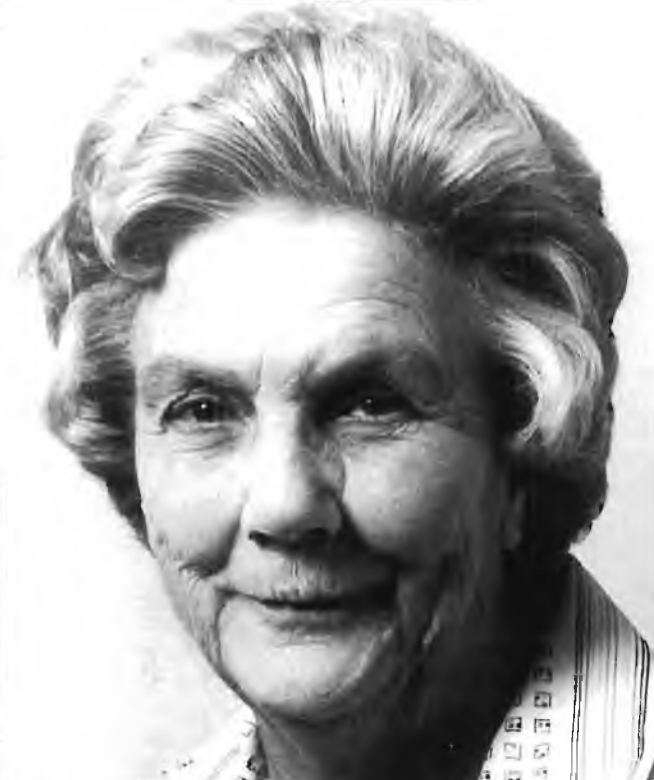
Integrity, exactitude, knowledge and wisdom, are appropriate adjectives for Molly Levy, foremost among the women who might qualify for the title “Mother of South African Physiotherapy”
Like many South Africans in the early years of the profession, Kate Molly Levy (nee Limerick) travelled overseas to qualify – in her case, she went to Ireland to train as a physiotherapist before returning to South Africa a few years later. She ran a private practice and taught at the University of the Witwatersrand, before embarking on what would prove to be a lifelong commitment by joining the leadership of The South African Society of Physiotherapy (SASP).
She was voted onto the Central Executive Committee in February 1948; in 1949, she became Assistant General Secretary and then she worked full-time as Honorary General Secretary in 1955, the year in which the new Constitution was adopted.
Molly served as First Vice-Chairman from 1969 until 1973, during which period she was one of the South African contingents to attend the 7th International Congress of the World Confederation for Physical Therapy (WCPT) in Amsterdam in 1970. At this Congress, South Africa had been elected to the Executive Committee of the WCPT as a general member. Molly wrote,
It was a proud moment for us all, and particularly for me, as it marks the culmination of my long and arduous career in the service of this society”.
Fortunately for The SASP and the profession, this achievement did not put period to her service. Molly went on to be National Chairman from 1973 until 1979, when she was elected President. She was the first physiotherapist to hold the position.
Her dedication was extraordinary – she spent every day in the office when she was chair, and later as president (the presidency at this stage was more non-executive function than it is today), thus freeing up the time of chairs who held full-time jobs.
On the Professional Board
From 1973 until 1978 Molly served as a member, and then Vice Chairman, of the newly established Professional Board for Physiotherapy, and finally as Chairman from 1978 to 1988.
Margaret Beattie served under her on the Board as vice-chair, and she said,
At the Medical Council meetings Molly, as chairperson of the Board, […] was highly esteemed and respected. When I occasionally stood in for her at such a meeting, I was overwhelmed by the number of medical colleagues asking after her and singing her praises. It gave me a warm glow and a pride in our profession.”
Over the years I served on many committees with Molly and remember her for always being 120% prepared for the meetings and for working behind the scenes to ensure they flowed more smoothly, yet firmly expressed the profession’s point of view. She also had the ability to inject humour to lighten up the proceedings. She strongly supported the profession on the many committees on which she served, at the same time conveying a professional yet feminine image.
Beatty continued,
I consider myself privileged to have known Molly, to have worked with her and to have had a colleague who did so much to promote the image and standing of the physiotherapy profession in the medical world in South Africa.”
International leader
From the 1950s through to the end of the 1980s, Molly Levy was a leading figure not only in physiotherapy locally but also internationally, and she travelled widely and often. It’s worth noting that she only received a modest honorarium to cover incidental expenses, and only in the latter years was she re-imbursed for travel expenses incurred in representing the Society nationally or internationally.
“When I went to my first WCPT meeting, in 1987,” wrote Sheena Irwin-Carruthers,
I discovered that to most of the members of WCPT, Molly Levy was The SASP and The SASP was Molly Levy. She must surely have been, over the early years of WCPT, one of the best-loved representatives at the General Meetings of the world body.”
Molly was the voting delegate on behalf of The SASP at the WCPT from 1959 until 1974; she then became a member of the Executive Committee of the WCPT, a position she held until 1978.
This was a difficult time for The SASP, as worldwide condemnation of the apartheid regime in South Africa took hold. Boycotts and shunning were the order of the day. Yet Molly promoted and facilitated lecture tours by prominent physiotherapists from other countries to ensure continuing professional education during the years of national isolation.
Her family treasured memories of those international figures:
They always spent the first few days with us, finding their feet. We remember the kindly Maria Ebner, the efficient Miss Nielsen, the vivacious Margaret List (who did handstands on the lounge carpet after a few cocktails one evening!), the gentle Joan Cresswell (who was so good to us on a return visit to Australia), the elusive Professor Roodt (who rushed us all over California during a visit there), the charming Barbara Sutcliffe (who entertained us frequently in London) and the professional Geoff Maitland (who hosted us to a wonderful evening in Adelaide).”
A year later, Molly attended her last WCPT Meeting, a special meeting in London.
“..made necessary because some countries had boycotted the 1987 meeting due to our presence. In 1988 we finally won the support of the other member-organisations, and Molly bowed out of the international scene.”
During the years of national isolation, it was Molly’s wide friendships, strong influence, and the esteem in which she was held by physiotherapists throughout the world which ensured that the SASP was not expelled from the World Confederation for Physical Therapy.
In 1987, the eponymous Molly Levy Lecture was established by The SASP as tribute to her extraordinary contribution to the physiotherapy profession.
References
Smallhorne, M, (1998). Molly Levy Tribute. SA Journal of Physiotherapy, 54(2), 3-5.
