

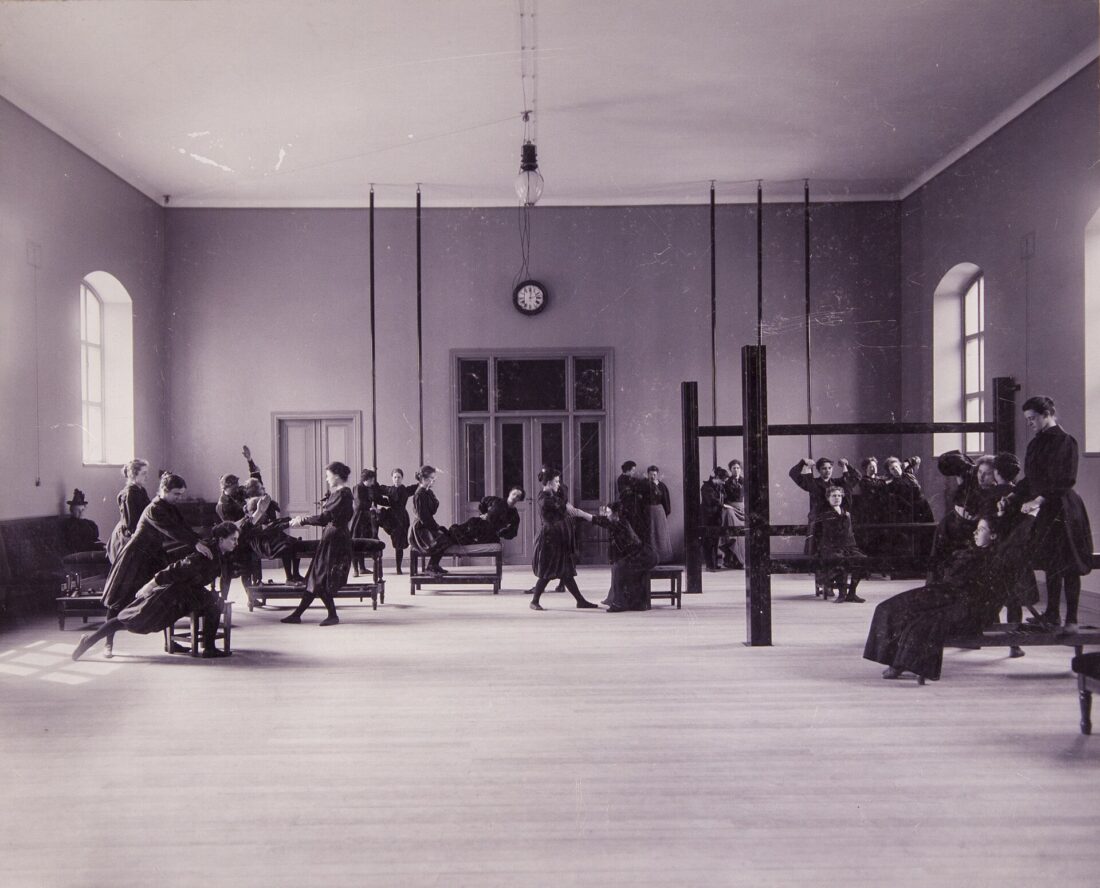
In the late 19th century, the medical world was turbulent, competitive, and surprisingly entrepreneurial. Among the more transformative developments was the rise of mechanical medicine—manual techniques, movement therapies, and massage—that challenged the conventional drug-based treatments (pharmacology) of so-called orthodox or regular medicine. While attention has been paid to the professionalisation and scientification behind these mechanical therapies, an equally important story lies in how they created emancipatory opportunities for women, which ultimately shaped physiotherapy into a predominantly female profession.
Royal Central Institute of Gymnastics
The story begins with Pehr Henrik Ling, a Swedish poet, fencing master, and founder of the Royal Central Institute of Gymnastics (RCIG) in 1813. The RCIG trained physical educators but Ling’s gymnastic system did not only promote the need for strength-improving regimes in school gymnasiums. He was perhaps even more concerned with “medical gymnastics” and how this needed to be based on science (physiology and anatomy). To that end he systemised many movements and manual massage-like techniques believed to have great curing capacity (without drugs). This meant that the RCIG’s students received a formal double competence, as experts on both the healthy and the sick body. If working with strength improving regimes they were called physical educators and if dealing with patients, they were called physiotherapists (then medical or remedial gymnasts). However, since salaried positions as physical educators were rare in 19th century RCIG’s alumni regularly had to work as physiotherapists to support themselves.
Initially, the RCIG’s student corpus bestowed of men only—army officers—who would go on to promote Ling’s system globally. This would start to change in the 1860s when women were admitted to the school, creating one of the first socially acceptable paths for upper- and middle-class women into professionalised healthcare. Like their male colleagues, and for the same reason, most RCIG’s female alumni operated physiotherapy clinics— thus making them also autonomous healthcare entrepreneurs with a strong professional identity as physiotherapists. Early on physicians too, became convinced of physiotherapy’s usefulness in combatting diseases, meaning that they, like the physiotherapists, promoted Ling’s allegedly science-based physiotherapy.
Mezger’s Medical Massage
RCIG-trained practitioners quickly became authoritative in mechanical medicine, leveraging Ling’s inventor status of “scientific physiotherapy” to fend off competition. Their growing confidence however, put the not-yet-hegemonic medical profession in a bind, unable to criticise the ‘lay’ practice from which they themselves also profited. Yet the field was far from static. In the 1870s, the Dutch physician (and fencer and physical educator!) Johan Mezger became recognised as the inventor of scientific massage, a method that carried formal medical credentials and added new legitimacy to ‘medico-mechanical’ hands-on therapy. Mezger’s international reputation skyrocketed after curing Prince Gustaf of Sweden’s crippling hip injury, a high-profile success that brought his massage instant fame. The concept of massage soon became a publicly recognised medical treatment on par with Ling’s physiotherapy.
This “massage-boom” also created opportunities for women—but at the same time it increased even more the competition and tension in the medical marketplace, and especially so in Sweden where physiotherapists were licensed by the government. RCIG’s programs were restrictive, producing far fewer graduates than demand required. This, in turn, gave room for new educational enterprises; private schools offering shorter classes in massage and physiotherapy to a growing number of women eager to enter a healthcare market with career opportunities. Initially these shorter classes came about to supply physicians and physiotherapists with assistants. However, the many women who took these classes soon mimicked what the RCIG-alumni did. They began offering massage and physiotherapy services in clinics of their own. Like RCIG-physiotherapists and physicians these so called “self-licensed” practitioners often advertised widely, creating a situation that challenged the professional authority of especially RCIG-trained physiotherapists. Legal protections were limited because the word massage was not explicitly mentioned in existing Swedish legislation, only physiotherapy, allowing the privately trained to operate in a grey area and, in effect, bypass already existing professional hierarchies and boundaries. Due to this Mezger’s massage terminology quickly blended with the nomenclature of Ling’s physiotherapy giving rise to the confabulated label “Swedish massage,” which continues today in many anglophone countries.
Medical Patriarchy
In this dynamic environment physicians saw an opportunity to improve their professional dominance. By order of tradition and legislation RCIG-trained therapists often worked autonomously, making independent diagnoses and treatment plans—which had long created tension with the medical profession who sought primacy in all things medical. RCIG-alumni, and the male physiotherapists in particular, were viewed as extra troublesome since they rejected working under orders from physicians. In Sweden there were even efforts from orthopaedists to prohibit men from becoming physiotherapists at the RCIG.
However, physicians found the growing number of “self-licensed” women more compliant, easier to collaborate with, and less threatening to their authority. This gendered dynamic contributed directly to physiotherapy’s emergence as a female-dominated field. Heterosocial bonds formed between male physicians and female therapists, where the former granted the latter access to training, patients, and legitimacy—but also shaping the physiotherapy profession along new gendered lines. Commercial pressures coming with the increased competition further reinforced this shift, and on a global scale.
By the 1890s, institutional and social pressures shaped professional boundaries. Scandals, particularly in London, cast doubt on the propriety of some women-operated clinics (they were rumoured to be brothels in disguise), prompting female therapists to seek the protection of the medical profession. Not least hospital affiliations could restore their professional reputation and create new stability and social legitimacy. For the same reason female physiotherapists began to organise in women-only associations. These had very strict rules for admittance, not least regarding the educational background of the applicants. To become a member, one had to have training from a carefully selected number of physiotherapy/massage schools. The common denominator of these schools were that were supervised or run by physicians. At the same time, male physiotherapists were largely excluded from these institutional roles including positions at the hospitals. The result was a professional landscape where women dominated both in numbers and visibility, but within a framework that required alignment with the medical establishment. After the turn of the 19th century women constituted the primary workforce and became integrated with the emerging orthodox or regular healthcare system.
Throughout this period, the interplay of gender, commerce, and fighting over scientific rights of interpretation defined the physiotherapy profession’s development. Women entered a field previously closed to them, leveraging commercial opportunity, legal ambiguity, and public demand to establish a profession. Physicians’ selective and gendered support, the problems autonomously working women started to face in the medical marketplace, the RCIG’s decline as an international point of medical reference in combination with the social acceptability of women in caregiving roles converged to make the physiotherapy profession completely female. The old “problematic” male physiotherapists, with no access to the female associations and the opportunities at the hospitals, were thus sidelined. They were exiled to operate in the private medical marketplace but no longer recognised as real physiotherapists but as irregular practitioners. By the early 20th century, the profession had consolidated: hospital positions, female networks, and regulatory frameworks reinforced the gendered structure that persists in many countries today.
Conclusion
In retrospect, the story of 19th-century beginning of the physiotherapy profession mechanical medicine is as much about social dynamics as it is about therapeutic innovation. Ling and Mezger provided the technical foundation, but women’s entrepreneurship, public demand, and strategic collaboration with physicians shaped physiotherapy into a female profession. What began as a revolutionary approach to medicine became a pathway for women into the professional world—simultaneously empowering and circumscribing them. Even as hospitals and professional organisations formalised the field, the origins of physiotherapy as a female-dominated profession remain visible in its history, institutions, and workforce today.
References
The above essay is condensed from the works of the author:
Ottosson A. (2005). Sjukgymnasten – vart tog han vägen? Sjukgymnastyrkets maskulinisering och avmaskulinisering 1813-1934, Göteborg.
Ottosson A. (2016). Androphobia, demasculinization, and professional conflicts. The herstories of the Physical Therapy profession deconstructed, Social Science History.
Ottosson, A. (2016). The Age of Scientific Gynaecological Masseurs. ‘Non-intrusive’ male hands, female intimacy, and women’s health around 1900, Social History of Medicine.
Ottosson A. (2016). One history or many herstories? Gender politics and the history of physiotherapy’s origins in the nineteenth and early twentieth-century”, Journal of Women’s History, ISSN: 1527-2036, s. 296-319.
Ottosson A. (2025). The Lost Origins of Osteopathy and Chiropractic in European Mechanical Medicine and Physical Education, C. 1800-1950. Routledge.
Ottosson A. The Battles over Scientific Natural Cures and their impact on the gendered division of labor in orthodox healthcare, c. 1850-1930. (manuscript, forthcoming).
