Physio History Quiz 1 Available
To celebrate the 75th anniversary of World Physiotherapy (formerly the World Confederation for Physical Therapy – WCPT) on 8 September …
On the 1st of January 1973, Jean Blair was appointed Associate Professor by the Council of the University of the …
Vibration has been, and is still, used widely across physiotherapy. The speed of the vibration offers differing therapeutic benefits that …
Today, the biography of Dr Johan Mezger was presented at the Amstel Hotel, Amsterdam, by author Prof Dr Peter Jan …
Last year we began work on the first ever special issue Physiotherapy Theory and Practice dedicated to the history of physiotherapy, and today the project moved a step closer. All eight draft papers were sent off for peer review today, and we’re posting all of the draft abstracts here so …
Those of you older than, say, 50, should have no trouble identifying these. So do you know what they are and what we did with them?
In De Arte Gymnastica, written in 1569, Hieronymus Mercurialis describes six exercise principles: Each exercise should preserve the existing health state Exercises should be suited to each part of the body All healthy people should exercise regularly Sick people should not be given exercises that might exacerbate existing conditions Special …
IPHA member Cameron MacDonald, along with Peter Osmothely, Robert Parkes and Darren Rivett have recently published an article in the Journal of Manual & Manipulative Therapy looking at the ongoing debate around the regulation of manipulative therapies in America. In the article, they take an historical approach to the question …
Most physiotherapists will have memories of learning about electrotherapy. Perhaps you learned from Clayton’s Electrotherapy and Actinotherapyabout sinusoidal currents and short-wave diathermy. And perhaps you still have waking nightmares about induction coils? Or perhaps, if you trained under Enid Gotts at the School of Physiotherapy in Dunedin, New Zealand, you’ll …
We had a really lovely post-WCPT meeting of the whole IPHA membership this week. You can find links to the agenda and audio recording here. There were some decisions made at the meeting that will shape some of the work of the IPHA for the next year or so: The …
Physiotherapy has a long history with light therapy. Throughout much of the 20th century, light therapies were an integral part of the therapists toolkit. And actinotherapy – or the therapeutic use of artificial non-ionising radiations, especially ultraviolet light and infra-red (Beckett 1955, 1) – has formed perhaps the largest part. …
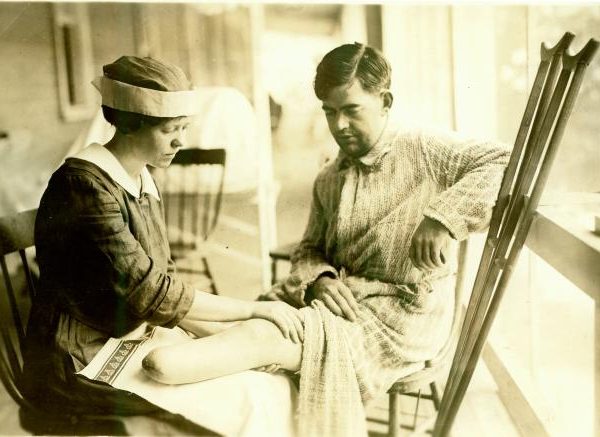
We are well accustomed to photographs of World War I physiotherapy wards. Busy rooms, filled with rehabilitating soldiers offer a glimpse into a past world and the beginnings of a new profession. In contrast, a painting of the very same scene offers far greater insight, as we get to see what …
A giant has died, the likes of which we will see no more. He was the right man at the right time. Physical Therapy had not yet become a profession when in the 1950’s Freddy Kaltenborn then of Norway and later of Germany, began his interest in mastering joint manipulation. …
Immobilisation of injured limbs has been performed for thousands of years and starch-based casts were the standard treatment, with only minor changes, until the beginning of the 19th century. Many centuries before it was introduced as a cast material, Plaster of Paris (PoP)* was well known as a building material. Egyptians …