

Vibration has been, and is still, used widely across physiotherapy. The speed of the vibration offers differing therapeutic benefits that can be targeted toward specific health conditions. Slow rhythmical rocking, via horseback (hippotherapy) or being sat upon a top loading washing machine, can be used to reduce high muscle tone and tremor. Middle frequency percussive massage like tapotement or via handheld machines stimulates the nervous system when applied to the muscles. Similar vibrations applied to the chest wall, used with postural drainage, loosen lung secretions. And high frequency vibration via hand held devices stimulate local low muscle tone and facilitate muscle contraction. Also at higher frequencies, modern whole body vibration platforms improve muscle strength and bone density through the creation of higher artificial G-forces.
Seemingly a recent phenomenon in health and therapy, the history of vibration is long and broad.
Ancient Greece
When Greek warriors sustained injuries or needed a method to speed up recovery, doctors would apply vibration by sawing pieces of wood or plucking bow-like instruments that were in contact with the body part. The vibrations allowed pus to drain from wounds more freely while also healing the wounds faster.
A simpler finding from this same time period was that riding on horseback or donkeys would speed recovery. Writings from Lucious Anneaus Seneca referenced the benefits of carriage rides with irregular wheels on uneven terrain that were helpful for preserving health and healing.
16th Century
In the 16th century a Japanese book mentions the potential benefits of vibrations for health. The application of vibrations for the relief of rheumatic disorders and the support of the cure of fractured bones by the application of vibrations was described.
18th Century
Charles Irenee Castel de Saint-Pierre, invented the so-called “tremoussoir” – an armchair with springs used to provide movement and exercise – and “fauteuil de poste” for the use on infirm persons to achieve positive effects on their nervous system and health
19th Century
In 1808, John Barclay wrote the book “The Muscular Motion of the Human Body”, in which he described a case where muscular spasm was cured with the application of vibrations. Throughout the 19th century vibration was cited to reduce morbidity, support cardiovascular health, and treat digestion and other ‘nervous diseases’.
French neurologist, Jean-Martin Charcot’s research into vibration began when he heard anecdotal evidence that patients with Parkinson’s disease noticed reduced pathology after long train rides or carriage rides. He took the common features of this kind of travel: the vibration, and invented a chair that would mimic the movement. His invention was used in 30 minute sessions on Parkinson’s patients and he introduced a level of variability that allowed control over frequency, intensity and vibration direction.

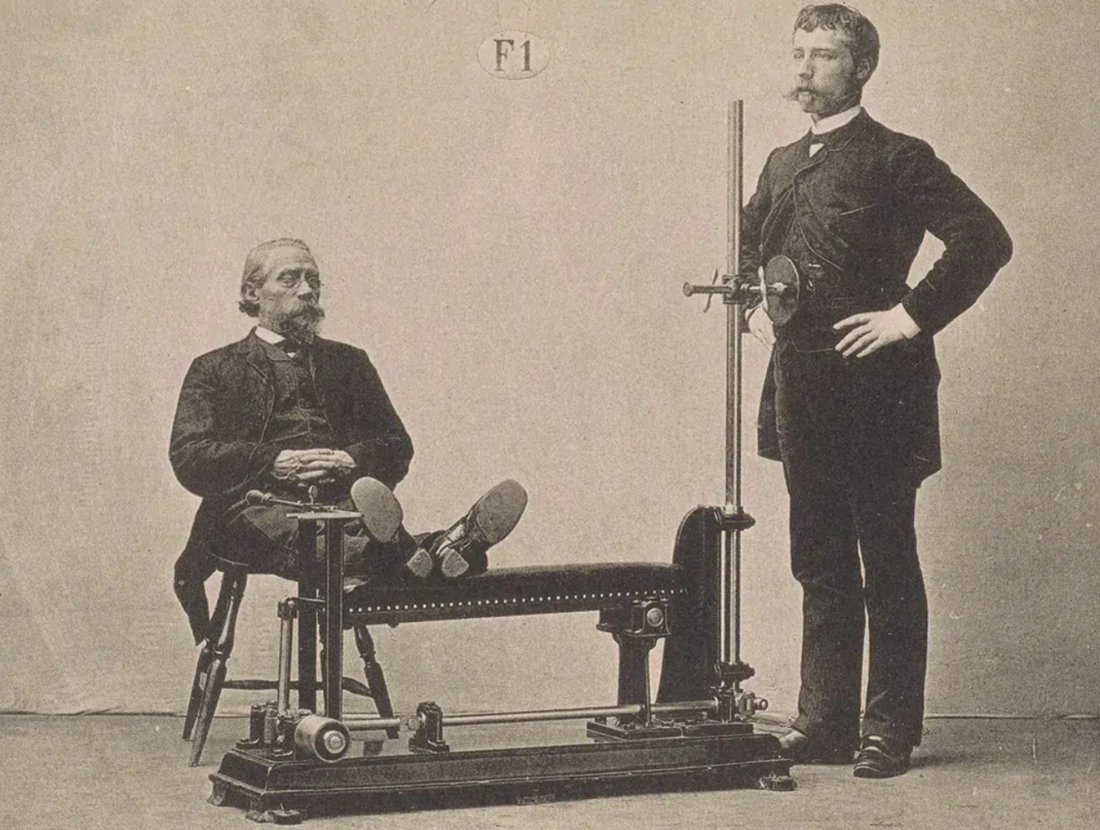
Zander Apparatus F2
Jonas Gustav Zander was a Swedish physician who established what we know as the modern gym. He tested pieces of equipment on patients, including one of his inventions called the ‘Zanderapparat F2’, pictured, which simulated a jog trot similar to the experience of riding a horse. He noted that his device helped stimulate weight loss and contributed to muscle gain. In 1895, American Dr John Kellogg of the Sanitarium and Cornflakes fame, improved upon Zander’s design and invented the first steam powered whole body vibration machines. He paved the way for modern machines with his chair and platform designs.
Electrical production of vibration allowed the development of the hand held vibrator, which became a useful tool for physicians using female genital stimulation for the treatment of ‘hysteria’ and other female disorders.
20th Century
Further vibration therapy innovation was sidelined until the middle of the 20th century, as a result of the world wars. In the 1960s, there was a renewed desire for health research and many scientists focused their efforts studying the effects of whole body vibration. Rhythmic Neuromuscular Stimulation is the direct ancestor of many devices that are available on the market today.
Vibration therapy was first fully embraced by Russia in the 1970s and further refined by Vladimir Nazarov to give their Olympic team a competitive advantage by helping the athletes speed up their recovery. Nazarov and his colleague Spivak were the first to make the connection that vibration contributed to muscular capacity increase, and could stimulate bone regeneration. This knowledge and therapy was applied to Russian cosmonauts who experienced a reduction in bone density as a result of their time in space, and this treatment helped them recover their strength following. In 1995, Russian cosmonaut Valery Polakev became the first man to spend more than 400 days in space thanks to the benefits of vibration therapy.
Scientists from all over the world began adopting vibration therapy in the 1990s. Americans used vibration therapy to prepare astronauts for their time in space. German scientists used it to help improve flexibility. Carmelo Bosco, and Italian physiologist, invented the modern day whole body vibration machine that became available for use in the homes or gyms of individuals for the first time.
Vibration therapy became more sophisticated and devices functioned by applying high-frequency sinusoidal vibrations in vertical and side-alternating directions. Vibration therapy became widely used in competitive sports to help assist in warm ups, cool downs, strength training, reduction of delayed onset muscle soreness and flexibility training.
References
Albasini A, Krause M & Rembitzki IV. (2010). Using whole body vibration in physical therapy and sport. London: Elsevier.
Goetz CG. (2009). Jean-Martin Charcot and his vibratory chair for Parkinson disease. Historical Neurology, 73(6), 475-478.
Kaeding TS. (2016). The Historical Evolution of the Therapeutic Application of Whole Body Vibrations: Any Lessons to be Learned? Austin Sports Medicine, 1(1), 1003.
Snow MLH. (1904). Mechanical Vibration And Its Therapeutic Application. New York: Scientific Authors’ Publishing Company.
Maines RP (1999). The technology of orgasm: Hysteria, the vibrator and women’s sexual satisfaction. Baltimore: The John Hopkins University Press.
