

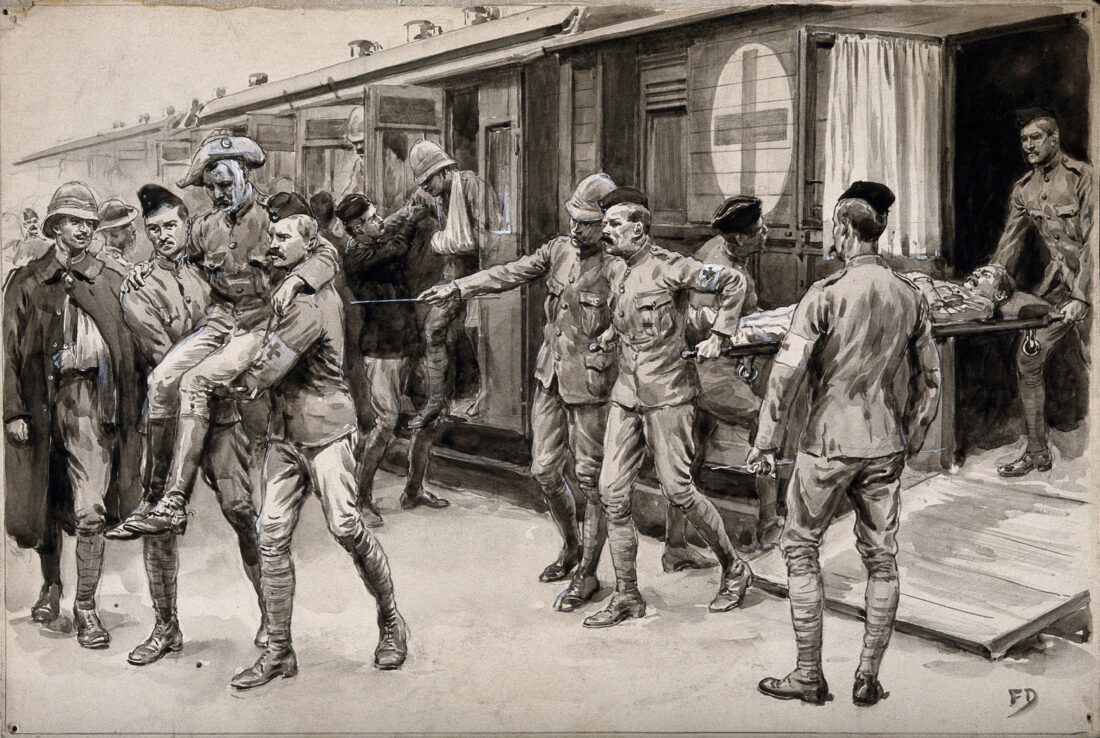
The First World War is considered the turning point for the institutionalisation and expansion of the physiotherapy profession. The sheer volume of injured personnel created by the mechanisation of arms, combined with emerging government social responsibility, facilitated support for a workforce trained to assist in physical rehabilitation. But the First World War was not physiotherapy’s first experience in such an environment. Fifteen years earlier, during the Boer War, members of the United Kingdom’s Society of Trained Masseuses (later to become the Chartered Society of Physiotherapy) had laid the groundwork that led to their immediate inclusion in the First World War (Nias, 2017).
The Boer War, also known as the Second Anglo-Boer War, was a bitter colonial conflict fought in South Africa from 1899 to 1902 (Wessels, 2024). The British sought to unite the two Boer republics of the Transvaal and the Orange Free State, with their existing territories of the Cape Colony and Natal. The Boers were fiercely independent Dutch, German and Huguenot (French protestant) populations who had settled in southern Africa in the second half of the 17th century, and had already trekked northward due to British expansionism into the Cape.
The war was the culmination of a decades-long struggle between Afrikaner nationalism and British imperialism. It was further fuelled by the discovery of rich goldfields in the Transvaal, and by the (in)famous empire-builder Cecil John Rhodes’s ambition for a British-controlled Africa from the Cape to Cairo.
Nurse Masseuses
It was in their capacity as nurses that members of the Society of Trained Masseuses (STM) travelled to South Africa (Wicksteed, 1948). Within just a few weeks of the outbreak of war several were already in the war zone, working under phenomenally hard conditions which were unlikely to allow for much time for massage. Nevertheless, letters and reports on interesting cases were published in the STM column of the Nursing Notes journal.
Meanwhile, back in the UK provision for disabled or discharged servicemen was considered the province of voluntary and charitable organisations rather than the state or military medical services. The masseuses demonstrated the evolution of their responsibility by providing after-care and rehabilitation when the STM organised massage volunteers to provide treatment for injured soldiers.
Nursing Notes published a number of accounts describing how the masseuses used a combination of physical therapies to rehabilitate soldiers. In one example, Florence Dove wrote of her treatment of an
…officer in the Highland Brigade, who was shot through the foot in action at Magersfontein’ in December 1899; the ‘conditions which ensued […] caused anxiety and a question of amputation’. On arrival in England the foot was very stiff, the calf muscles much wasted, and any hope of being able to march seemed remote. After a few weeks’ massage of the foot and leg and tip-toe exercises the limb became normal again, and the officer passed his Medical Board and returned to the front and his foot has given him no more trouble” (Wicksteed, 1948).
While the numbers treated were small, it demonstrated an early co-ordinated effort towards organised rehabilitative provision for injured servicemen, and that masseuses were equipped to use a range of physical methods in their treatment.
In the wake of the war Royal Army Medical Corps orderlies started to be trained in massage; and in January 1905 the STM was asked to examine candidates on behalf of the War Office. By May 1905 the Director General of the Medical Services had become a medical patron of the Society. And the Society’s articles of association that provided only for the examination of women, was altered to include men by the Board of Trade.
The incorporation of massage into the Army, and later Naval, medical services, demonstrates the broad appreciation of its value for rehabilitation, and such official endorsement also raised the credibility of the massage profession. In this context, the STM was able to further cultivate an identity of civic self-sacrifice and hinge the profession to public interest.
Conclusion
From the outset of the First World War in 1914, Britain now had an organised body of personnel, expertise and experience in rehabilitation to draw upon. In contrast few within medicine had experience treating patients with traumatic injuries before 1914. Apart from Robert Jones’s experience handling trauma at Liverpool and the Manchester Ship Canal project, orthopaedics had largely focussed on the congenital deformities of children, and was therefore ‘hardly the most obvious group to be beckoned’ (Nias, 2017). The immediate mobilisation of the massage profession, however, suggests by contrast, that physiotherapy was considered a logical response to the crisis of rehabilitating the nation’s soldiers.
References
Nias K. (2017). Negotiating intimacies: Gender, rehabilitation and professionalisation of massage in Britain, c.1880-1920. PhD thesis submitted to Exeter University. Accessed online at https://www.proquest.com/openview/63678b7244d4bbf945099a3fb34259e3/1?pq-origsite=gscholar&cbl=51922&diss=y.
Wessels, A. (2024). Anglo-Boer War: how a bloody conflict 125 years ago still shapes South Africa. The Conversation, October 10. Accessed online at https://theconversation.com/anglo-boer-war-how-a-bloody-conflict-125-years-ago-still-shapes-south-africa-240162
Wicksteed, J. (1948). The growth of a profession. Edward Arnold & Co: London.
