


In 1812, the Swedish government approved Pehr Henrik Ling’s application to teach gymnastics in Stockholm and receive a salary and premises through state assistance. Ling had developed a comprehensive system that included pedagogical (physical education), aesthetic (dance), military (fencing) and medical (physiotherapy) gymnastics; with the purpose of raising the physical fitness and health of the military and the general population.
Royal Central Institute for Gymnastics
Ling founded the Royal Central Institute of Gymnastics (RCIG) in 1813 and was given premises in a disused cannon foundry just north of the city – located at Hamngatan 19. From this unassuming location arose a powerful global force in exercise and health during the 19th and early 20th centuries. It has subsequently been described as Sweden’s greatest cultural export (Lundquist-Wanneberg, 2015). Not least, was its contribution to the formation of the physical education and physiotherapy professions.
As Stockholm rapidly grew the RCIG’s location on Hamgatan became more central and the land upon which it stood, more valuable. Following the Second World War, the now-named ‘GIH – Swedish School of Sport and Health Sciences’ (both physiotherapy and military physical education had been earlier removed) was relocated further north onto a rocky hill overlooking the Olympic Stadium – built for the 1912 Games (Kierkegaard, 2015).
The Hamgatan, and nearby, buildings were ultimately razed and Sergels torg (Sergel’s square), a public plaza, constructed in the 1960s. It was named after 18th century sculptor Johan Tobias Sergel, whose workshop was once located north of the square. Sergel’s torg is today the primary plaza for the city. Surrounded by cultural, commercial and retail buildings, and containing an underground mall and metro station, it is a popular space for meeting friends, holding political demonstrations and celebrating national sporting victories.
The Statue
In preparation for its 175th anniversary in 1988 the GIH raised funds for a memorial sculpture to be placed at Sergel’s torg – at the site of the RCIG’s original location. Commissioned sculptor Peter Linde (2025) recalled being provided with pictures of the starting positions for ten of Ling´s exercises as ideas for the sculpture. He explained his choice,
I considered that since the spot where the sculpture should stand, was right in the middle of Stockholm’s most stressful place, Segels Torg, with a lot of traffic all day long, I found position number 2 (as far as I remember that was the number) the most calm and meditative of them all! Looking almost like a Yoga meditative position! The place needed something calm, I thought!”
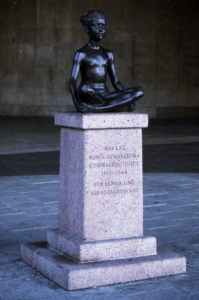
Cross legged girl statue on plinth.
The bronze sculpture, titled ‘Korssittande Flicka’ (Cross-Legged Girl), was placed on a plinth on the sidewalk of Hamngatan, just east of the Kulturhuset (House of Culture) (GIH 200 år, 2013). The statue’s inscription translates to,
HERE WAS THE
ROYAL CENTRAL INSTITUTE FOR GYMNASTICS
1813 – 1944
PEHR HENRIK LING
WAS THE FOUNDER
In reality, the girl’s cross-legged sitting position is an exercise from Elin Falk’s book, “Day Exercises for Stockholm Elementary Schools” (Plaque, 2013). Falk was a graduate of the RCIG in 1895. She spent the first few years of her career working abroad, initially as a gymnastics teacher and physiotherapist at the Young Women’s Christian Association in Baltimore, USA. Falk went on to hold similar positions in Britain and Denmark, before returning to Sweden in 1898. She became a gymnastics inspector at public schools in 1910 and continued in this role until her retirement in 1932.
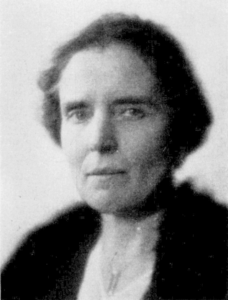
Elin Falk
Falk developed special exercises for children in schools, designed to be fun and engaging. Her work included more natural and rhythmic postural exercises that contradicted the military-style and ‘stiffer’ Swedish gymnastics of the time (Carlquist, 1940). The publication of her book ‘Gymnastikfrågan vid Stockholms folkskolor’ (The Gymnastics Issue in Stockholm’s Primary Schools) in 1913 led to controversy in the conservative world of Swedish gymnastics and gave rise to what the press called, “the Gymnastics Battle at Stockholm Elementary Schools” (Lundquist-Wanneberg, 2015). Nevertheless her work ultimately gained favour.
Stolen
Reconstruction work in and around Sergels torg saw the statue placed into temporary storage (Kierkegaard, 2025). On 11 June 2018 the City Museum became aware that one of their storage warehouses had been burgled (Lodding, 2018). The Cross-legged Girl and three other missing statues were reported to the police and the artists notified. The City Museum was pessimistic about the chances of getting the works back suspecting that they may have been melted down.
Prior to the theft, to celebrate its 200th anniversary in 2013 the GIH commissioned a smaller replica of the ‘Cross-legged Girl’ statue and placed it in their library. However the original statue’s whereabouts remain unknown and with her absence the location of the original RCIG of Pehr Henrik Ling is lost to the world.
UPDATE – Statue back in place
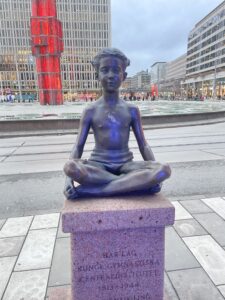
‘Cross-legged girl’ statue back in place. Photo taken January 2026.
The International Physiotherapy History Association (IPHA) wrote to the Stockholm City Council in December 2025 requesting that the ‘Cross-legged Girl’ statue be replaced. Head of Stockholm Art, Elanora Fors Szuba (2025) advised that the statue was never stolen and was replaced in Spring 2024 once the renovations to the area were complete. We sought help from two Swedish members of the IPHA to visually confirm that the statue was back in place – see photo.
We apologise to our members for providing incorrect information and to the Stockholm City Council for falsely accusing them of losing the statue. How the media came to report that the statue was stolen remains unknown.
References
Carlquist M. (1940). With the least possible tension: The governing principle of a development of Ling’s gymnastics. Health and Physical Education, 11(1), 6-10, 53-54.GIH. (2013).
Fors Szuba E. (2025). Email to Glenn Ruscoe, 1 December 2025. Archives of International Physiotherapy History Association.
GIH 200 år: Svensk Kunskap, Hälsa och kraft. [GIH 200 years: Swedish knowledge, health and strength]. (2013). GIH. Translated by ChatGPT.
Kierkegaard S (Ed). (2025). GIH’s building history. Website of the GIH – Swedish School of Sport and Health Sciences. Accessed online at https://www.gih.se/om-gih/var-historia/gihs-byggnadshistoria.
Linde P. (2025). Personal communication.
Lodding M. (2018). Bronze girl from Sergel’s Square stolen. SVT Nyheter website. Accessed online at https://www.svt.se/nyheter/lokalt/stockholm/bronsflickan-fran-sergels-torg-stulen
Lundquist-Wanneberg, P. (2015). An analysis of “The gymnastic battle at Stockholm elementary schools”. Polish Journal of Sport Tourism, 22, 106-113.
Plaque. (2013). Korssittande flicka statue. GIH – Swedish School of Sport and Health Sciences, Stockholm, Sweden. Translated by Google Translate.
