

The formation of the Society of Trained Masseuses (STM) by four British nurses in 1894 is often opined as the beginning of the physiotherapy profession (Ottoson, 2015). In support, physiotherapy historian and critical thinker Dave Nicholls (2016) said on the subject,
..physiotherapy must be seen to begin when the question of organisation and regulation around a particular professional code becomes necessary.”
Alternatively, it might be considered overly generous to label the single-modality masseuses of the United Kingdom as anything more than masseuses, despite their organisational activity. With this perspective modern physiotherapy may be said not to have begun until they, at least, became multi-modal.
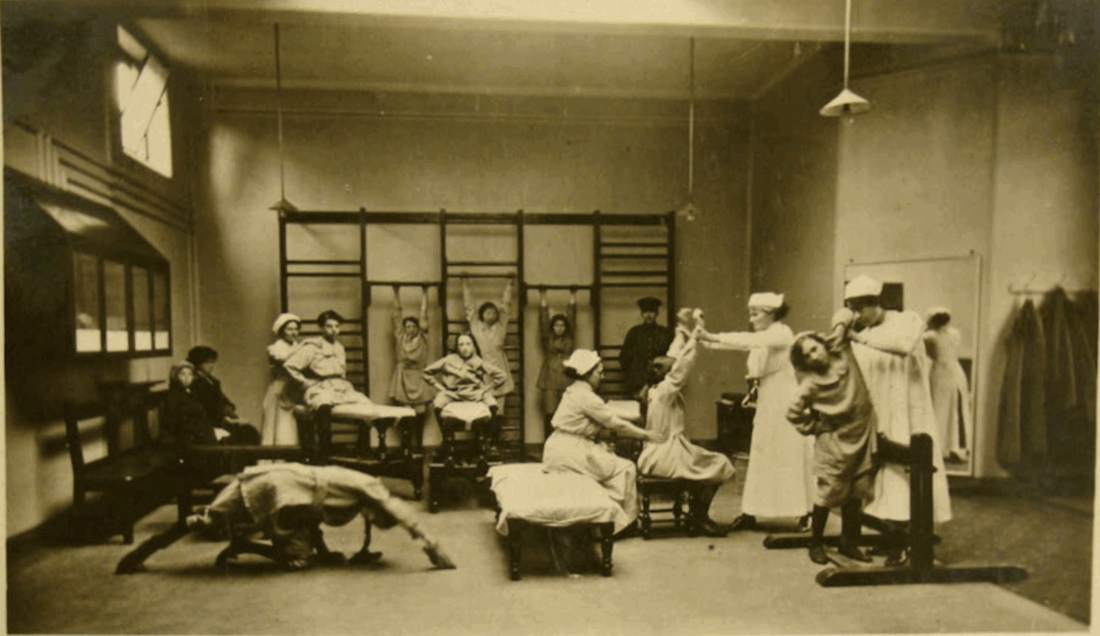
This article seeks to explore the why, how and when of the adoption of remedial gymnastics by the British masseuses, and how it facilitated the metamorphosing of single-modality massage into multi-modal physiotherapy. The personal experience of London-based Swede, Dr Koch is entwined within the story because of how well it embodies the broader explanation.
Almost all of the specific information provided is drawn from the work of physiotherapy historian Kay Nias’ (2017) PhD thesis but the broader principle also comes from the work of Anders Ottosson (2015).
Swedish Remedial Gymnastics
From as early as the 1830s, Swedish remedial gymnastic disciples and other zealous advocates from the Royal Central Institute for Gymnastics in Stockholm migrated to major European cities, and cities of North and South America; taking with them and adapting the ideas of founder Pehr Henrik Ling. Many migrated to Britain and their significant early impact was described by Jane Wicksteed (1948), author of the history of the Chartered Society of Physiotherapy (previously the STM) 1894 – 1945. She wrote,
This revival of massage and medical rubbing was largely due to the migration to this country of a considerable number of Swedish men and women trained in massage and education and remedial gymnastics at the Central Institute of Stockholm. These Swedes were usually well trained, well educated, competent, robust and vigorous..”
By the end of the nineteenth century, Swedish gymnasts were a familiar presence on the British public and medical landscape; they ran lucrative private practices and were frequently employed in general hospitals. From the 1870s Swedish gymnastics had also spread beyond health care provision into physical education. Universal education for British children had highlighted their poor health and the well-qualified graduates of the RCIG were employed in lead roles to get them into shape. Public interest in physical education grew and the Swede’s subsequently trained local gymnasts to spread their work. Swedish gymnastics was adopted by the British Navy in 1903 and by the Army in 1906.
In 1899 a group of the locally-trained gymnastic alumni founded the Ling Physical Education Association (Ling Association):
..with the intention of placing physical education on a higher basis than before; of ultimately obtaining a registered list of those qualified to teach Swedish gymnastics and to give massage in a thoroughly trained manner.”
As the quote above demonstrates, the Swedish-trained English gymnast was clearly providing multi-modal care and therefore may even be considered to have a prior claim to that of the STM’s to the title of the beginning of physiotherapy.
The Rise of Dr Koch
In April 1904 the Swedish Dr Koch and his Danish wife were appointed at the London hospital to provide Swedish massage and exercises. They were to work alongside the nurses in a six-month trial, treating patients sent to them by the Massage Department, four afternoons a week, with Dr Koch treating men and Mrs Koch treating women. It is important to note that Dr Koch was not a medical practitioner, rather he had earnt the prestigious Swedish title ‘Director of Gymnastics’ and shortened it to ‘Dr’ (with or without intention to be conflated with a physician).
Soon the London Hospital found that the growth of Dr and Mrs Koch’s work had been enormous and by February 1905 Dr Koch was asked to draw up a curriculum to supervise the training of nurses. Ultimately there emerged, quite organically, a ‘Swedish division’ to the London Hospital’s massage department.
The incorporation of Swedish expertise into British hospitals signals that there was a gap within British medicine for specialist expertise in the field of the physical therapies, and acknowledges the high status of Swedish gymnasts as professionals in this field. Because they operated in a sphere of little interest to British medicine a working relationship, rather than one of hostility, was able to emerge in the late-nineteenth century. However, these amicable relations began to break down as medical interest in physical therapies increased.
Massage’s Metamorphosis
The prestigious status of Swedish gymnasts as professionals and specialists contrasted with the low status of those who traditionally worked in the field of manual therapy in Britain, such as rubbers and bonesetters. For this reason, the Swedish gymnast offered a professional model that those interested in raising the status of the British massage profession sought to emulate. One of the primary ways they did so was by drawing from Swedish training and expertise. Theoretical and practical knowledge gained through education, training and examinations was one way that the STM sought to elevate the massage profession and distinguish massage as a specialist discipline distinct from the ‘rubbing’ of their local competitors.
Another important development of the early massage profession was the diversification of its skill-set and therapeutic territory. The STM quickly realised the importance of physical exercise alongside massage for the survival of their profession. Increasingly, training in massage was considered the starting point rather than the finish of a masseuse’s education and it was expected that anyone who said she was trained in massage would also have been trained in remedial exercises. Throughout the first decade of the twentieth century the STM sought to provide training for its members in Swedish remedial exercises, and by 1909 held its first independent examination on the subject. It was considered a ‘senior’ qualification that required candidates to undertake a six-month course of training.
Aside from physical exercises, masseuses also extended their expertise into ‘medical electricity’ and a range of heat and water treatments. By 1914 the masseuse was a multi-skilled practitioner and the massage profession represented expertise in a range of physical therapies. The STM was able to distinguish itself as an authority in physical treatments and rehabilitation distinct from both rubbers and ‘nurses who did massage’.
Cooperative Competition
By emulating the Swedish model of training the British massage profession closed the gap between continental and local expertise and was able to occupy a therapeutic territory increasingly important within British medicine. Whilst the Swedish doctrine remained popular, the British masseuse was now able to compete for territory.
As the skillsets of the British masseuse and Swedish remedial gymnast became similar their professional attitudes became more evidently different. Where Swedish trained gymnasts operated relatively independently of the medical profession, the nursing-aligned ‘female’ masseuses of the STM pledged to work only under the orders of a medical doctor. It was through this allegiance that the British massage profession established a working relationship with British medicine, and thereby began to absorb some of the technical and labour intensive aspects of physical treatments that were now entering into medicine’s consciousness.
The ability and independence of the Swedish gymnast began to unsettle the economic interests and authority of the medical practitioner. It was complained,
..that the patient is given to understand that no one knows anything outside Sweden of this work, and the patient returns to the medical man no more.”
The pushback occurred in hospitals where, in the name of efficiency, medical committees sought to increase their level of supervision over the massage departments. There emerged a clear division of labour which protected the position and interests of medical men, and foreign practitioners were increasingly ostracised.
Dr Koch’s Emasculation
At the London Hospital, the absence of a medical officer in charge of the massage department had meant that, in practice, Dr Koch and the nurse-masseuse assumed this authority. This situation and especially the privileged position of an independent non-physician, Dr Koch, became a cause of angst for the hospital’s medical staff. A massage committee, made up primarily of medical practitioners, aimed to reorganise the department to make it more ‘efficient and productive’.
By May 1906, the London Hospital’s massage committee planned to quietly replace Dr and Mrs Koch with a suitable woman teacher who has been trained in Sweden, or trained in England by Swedish methods. The replacement of Dr Koch indicates how the London Hospital assimilated valuable Swedish expertise while sidelining competing Swedish experts. The medical profession devolved the work to ‘sufficiently trained’ local women who would ‘better understand’ the hierarchical relationship they believed should exist between members of the medical profession and masseuses. This ostracisation of Dr Koch demonstrates how the massage profession was a vehicle through which the field of physical therapy expertise was incorporated into British medicine and the Swedish practitioner marginalised. Central to this action was that at the same time as the expertise of the British massage profession increasingly developed to mirror that of the Swedish gymnast, the British masseuses held steadfast to their historical nursing ethics that bound them to work strictly under medical authority.
This was the process of professionalisation that placed British masseuses in a prime position to become ‘indispensable’ to the British medical profession and take the place of foreign competition.
Conclusion
The British hospital massage department initially evolved to represent a demographic of patients and treatment modalities on the margins of medical practice. They became places that medical men sent and lost sight of difficult or uninteresting patients. It was in this context of medical disinterest that nurses and masseuses took the initiative to develop a therapeutic territory that would make them an ‘indispensable’ medical auxiliary. Drawing from the professional models of nursing and Swedish gymnastics, the massage profession became an authority in a field of expertise largely unfamiliar to the majority of medical practitioners.
Both models were key to the professionalisation of massage: alignment with nursing guaranteed their alliance to medicine and emulating Swedish gymnastics offered specialist knowledge and status. This process of professionalisation occurred because both medicine and massage benefitted. While the massage profession carved out and secured a role within medicine, the medical profession gained an auxiliary expertise that enabled it to extend its therapeutic scope while maintaining its economic and professional aspirations.
To better reflect the greater breadth of its member’s work the Society of Trained Masseuses renamed itself the Chartered Society of Massage and Remedial Gymnastics, and later the Chartered Society of Physiotherapy. Sadly, nothing is known of what happened to Dr and Mrs Koch.
References
Nias K. (2017). Negotiating intimacies: Gender, rehabilitation and professionalisation of massage in Britain, c.1880-1920. Thesis submitted to Exeter University. Accessed online athttps://www.proquest.com/openview/63678b7244d4bbf945099a3fb34259e3/1?pq-origsite=gscholar&cbl=51922&diss=y on 30 May 2025.
Nicholls D. (2016). When was physiotherapy born? Website of the Critical Physiotherapy Network. Accessed online at https://criticalphysio.substack.com/p/when-was-physiotherapy-born on 30 May 2025.
Ottosson A. (2011). The manipulated history of manipulations of spines and joints? Rethinking orthopaedic medicine through the 19th century discourse of european mechanical medicine. Medicine Studies, 3(2), 83-116.
Ottosson A. (2015). One history or many herstories? Gender politics and the history of physiotherapy’s origins in the nineteenth and early twentieth century. Women’s History Review.
Wicksteed, J. (1948). The growth of a profession. Edward Arnold & Co: London.
Response from Dave Nicholls
Thanks for another really interesting piece Glenn. There’s a lot in here I like, but there are also a couple of things I bumped up against
We’ve talked about this before, but personally I don’t see a connection between the ‘birth’ of the physiotherapy profession and any particular modalities. I don’t think you can trace the origins of physiotherapy to the use of gymnastics, massage, or any other modality because these have been practiced by all civilisations since the dawn of time. In that respect, physiotherapy was no more born in 1894 than it was with Ling in the 1830s. You could just as easily say that physiotherapy began in Athens in 500 BCE. So whether physiotherapy begins with one, two, of twenty-two modalities seems to me to be erroneous.
What I’ve always argued is that the birth of the profession was a governmental issue; born of a series of social ruptures that provoked a number of social responses. (The End of Physiotherapy was a long meditation on this question.) Some of these responses took the form of small professional societies and guilds. Some of these succeeded, many did not. There were many massage and gymnastic organisations set up at the end of the C19, the STM and Ling Institutes being just two, but a lot of these faded into obscurity: some because they would insist on training men (an inadequate answer, it turned out, to prevailing social attitudes towards the sensuality of touch), or, more tellingly, because they could not attract sufficient medical patronage. The STM was singularly successful in this regard, not least because it’s founders, like Rosalind Paget, were women of significant social standing.
Which brings me to a second disagreement, and that’s with the use of the word ‘emasculation’ in reference to Dr Koch. I think this hints at Anders [Ottoson’s] work, which in the past has not-so-subtly suggested that physiotherapy missed out on some social prestige by becoming female dominated.
I think you’re more balanced in your discussion here, Glenn, because I think you highlight the necessary political choice made by the STMs founders in deliberately positioning the profession as subservient to medicine. I think we forget sometimes that aligning with medicine proved hugely valuable for the STM because it allowed them to use doctors as filters: to separate out those patients who required ‘medical’ massage from those who were just looking for a prostitute. It also allowed the profession to set up strong rules about professional conduct and raise standards, because unless students learned how to understand medical practice, they wouldn’t be allowed to access medical referrals through the STM’s central registry. This meant they would be exposed to competition from poorly trained ‘hacks’ and purveyors of ‘other’ massage services.
I think the use of the word emasculation also somewhat demeans exactly how brave and fearless these women were. It’s entirely possible that the STM provided the first recorded example of any new female-dominated profession that broke from the traditional sisterly, domestic constraints of women’s healthcare labour exemplified by nursing and midwifery. That’s quite remarkable in itself. So yes, gender was a massive issue in the formation of the profession, but I’d personally like us to think of it in more gender positive terms.
