

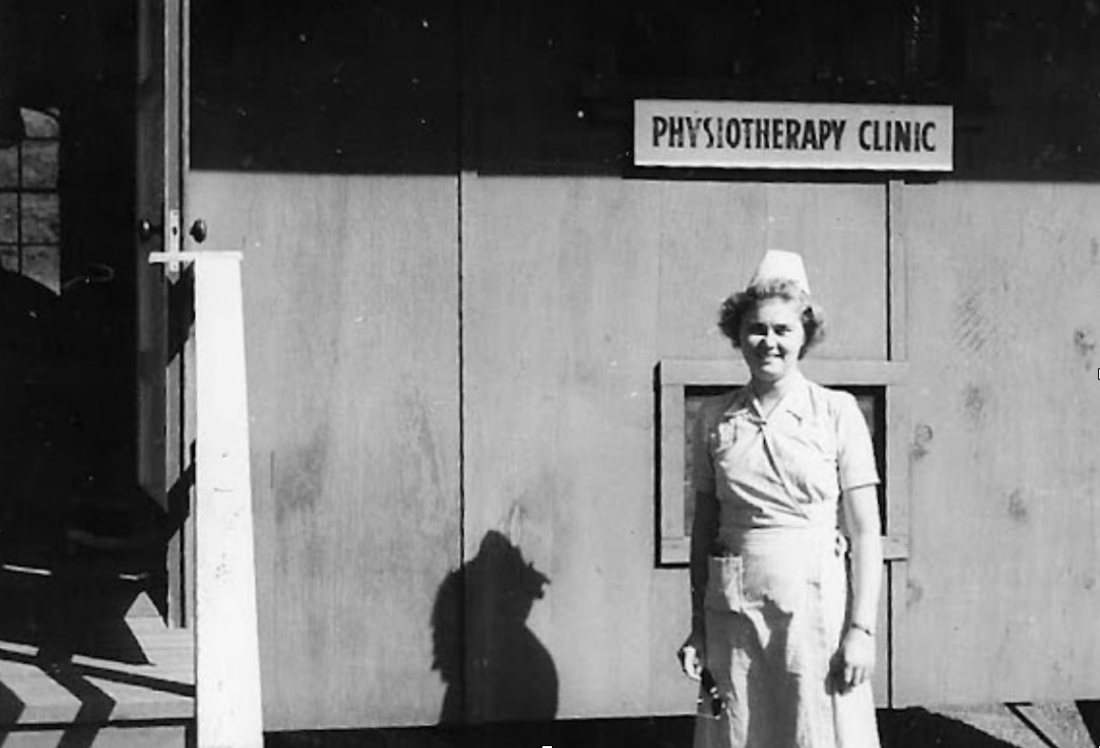
The untold story of how war, necessity, and innovation transformed physiotherapy forever.
When today’s US physical therapists evaluate a patient without a referral, few realise that the roots of this autonomy stretch back to the battlefields of the 20th century. Long before “direct access” became a catchphrase for professional independence, US Army physical therapists were quietly reshaping clinical practice in the most demanding environments imaginable — war zones, field hospitals, and rehabilitation wards filled with the wounded and the weary.
A new collection of personal recollections, Evolution of Neuromusculoskeletal Evaluation and Direct Access (see below for full access), edited by LTC (Ret.) Timothy L. Kauffman, PhD, FAPTA, brings these stories vividly to life. Spanning the First World War to the conflicts of the Middle East, it chronicles the experiences of Army physical therapists whose courage and competence helped redefine what it means to be a clinician.
Reconstruction Aides: The Birth of a Profession
The profession of physical therapy was forged in the United States in the crucible of crisis. Polio epidemics in the early 1900s and the carnage of the First World War created an urgent need for trained rehabilitation specialists. The US Army responded by establishing programs to train “Reconstruction Aides” — the precursors to modern physical and occupational therapists.
In 1921, these pioneering women, led by Mary McMillan, founded the American Women’s Physical Therapeutic Association, the forerunner of today’s American Physical Therapy Association. Army orthopedist COL Joel Goldthwait wrote in the first issue of P.T. Review that the war had proven,
even severe injury need not lead to serious disability, provided suitable treatment…can be given.”
He recognised that the therapists’ contribution had “so definitely established” the principles of physiotherapy that civilian hospitals would soon follow the Army’s lead.
That same spirit — disciplined, evidence-based, and quietly revolutionary — would characterise Army physical therapy for the next century.
Women at the Frontline
The Second World War and the conflicts that followed offered no shortage of challenges for Army therapists, many of them women serving in extraordinary circumstances. 1LT Myrl Jean Hughes recalled shipping out to New Guinea in 1943 at the tender age of 21, evading submarines along the way. Concerning physical therapy she remarked,
“We werent allowed to do anything on our own. Now they get advanced degrees and can do anything they like.”
Her colleague, 1LT Bette Horstman, trained at the Mayo Clinic before being deployed to the Pacific. She treated burns, sprains, and fractures under combat conditions and bristled under the nursing chain of command until she fought successfully to report directly to physicians — a small but significant victory for professional autonomy.
LTC Priscilla Gilchrist’s career spanned three wars, from the Battle of the Bulge to Korea and then arriving in Vietnam during the Tet offensive in 1968. Additionally, she was the consultant to the Surgeon General on physical therapy operations. She observed that the wounds she treated in Vietnam were worse than in the previous two wars because the weapons were more destructive.
Necessity Breeds Innovation
The turning point came during the Vietnam War. The shortage of physicians — especially orthopaedic surgeons — forced the Army Medical Department to rethink how healthcare could be delivered in the field. In the absence of doctors, physical therapists began evaluating and managing neuromusculoskeletal injuries independently. This necessity became the seed of “direct access.”
Kauffman, who served at Madigan General Hospital in 1973, recalls being informed by his superior that because of physician shortages, “we would be granted new privileges as PTs.” Soldiers with uncomplicated low back pain could report directly to physical therapy without a physician referral. Therapists could order X-rays, issue limited-duty profiles, and prescribe simple medications such as APC (Aspirin, Phenacetin, Caffeine). Kauffman remembered,
None of the orthopaedists enjoyed seeing so many back pain patients. They were ecstatic when PTs took on that responsibility.”
The model was so effective that it spread to other Army hospitals and later influenced the civilian sector, where it became a rallying point for professional independence.
Building the Knowledge Base
For autonomy to be sustainable, education had to evolve. The Army’s physical therapy programs, grew into graduate and doctoral degrees through partnerships with Baylor University and later the U.S. Army-Baylor Doctoral Program in Physical Therapy.
COL Virginia Metcalf, who served from the 1950s through the 1980s, described this evolution as “an outstanding accomplishment of all the staffs and faculties throughout the years.” She witnessed the transformation from technicians to diagnosticians — clinicians capable of evaluating neuromusculoskeletal disorders and contributing directly to patient management.
By the 1970s, structured training in manual therapy and differential diagnosis became standard. Courses taught by figures such as Florence Kendall, Stanley Paris and Army leaders like COL David Greathouse, COL Duane Saunders, and COL Doug Kersey formalised the process of neuromusculoskeletal evaluation (NMSE). Greathouse recalled,
We were being trained as physician extenders. Our programs in orthopaedics, radiology, pharmacology, and lab studies prepared us for independent evaluation and treatment.”
Direct Access Takes Shape
The Army didn’t simply permit direct access — it built a framework for it.
At Fort Riley, Kansas, Greathouse and his team developed one of four demonstration sites for NMSE, complete with physician oversight and continuous quality improvement. These pilot projects proved that PTs could safely and effectively serve as first-contact providers for musculoskeletal conditions.
When the Office of the Surgeon General later formalised the NMSE credentialing process, Army therapists were already functioning as autonomous practitioners. By the 1980s, the credential known as the “8G identifier” signified an Army physical therapist trained in advanced neuromusculoskeletal care — a military counterpart to today’s board certification.
Many of the therapists interviewed by Kauffman noted how their Army training sharpened their clinical instincts. COL Bill O’Grady, for example, recalled detecting a malignant melanoma and a spinal tumour in patients referred for “back pain.” He said,
The Army taught me to be confident, but also wary of red flags. Know your limits, but never doubt your clinical judgment.”
Courage Under Fire
For many of these therapists, clinical innovation came hand-in-hand with danger. LTC Barbara Reid described treating wounded soldiers under fire during the Tet Offensive at Qui Nhon. Equipment was scarce, much of it homemade from metal scraps and lead shot, but clinical ingenuity was abundant.
LTC Aida Nancy Sanchez, a physical therapist, was dispatched on a secret mission to Cambodia to treat President Lon Nol after a stroke. She was the only American allowed in the palace — and, thus she was asked by the US State Department to identify persons around President Nol. It upset her that she was supposed to treat the Cambodian President and spy for the government. Such stories reveal not only the therapists skill but also their moral and emotional fortitude. They served as clinicians, soldiers, and sometimes diplomats — all while expanding the frontiers of their profession.
From Army Clinics to Civilian Practice
As soldiers returned home and Army-trained PTs transitioned into civilian roles, the philosophy of autonomous practice followed them. The research, educational models, and clinical confidence developed in Army hospitals helped drive legislative changes that eventually allowed direct access to physical therapy across the United States.
COL Ron Franklin, who taught at the Army-Baylor Program, noted that
it was assumed that our graduates would experience evaluate, treat, and refer if necessary’ — that was the expectation.”
The Army’s approach anticipated modern evidence-based practice, long before it became a civilian standard.
Even outside military walls, former Army therapists became champions for independence. COL Duane Saunders advocated for direct access legislation in Kansas, crediting his Army experience with showing that PTs can safely provide NMSE.
A Legacy of Leadership
What emerges from Kauffman’s compilation is not just a military history but a professional lineage — one of courage, intellect, and relentless progress. From the Reconstruction Aides of 1917 to the doctoral graduates of the 21st century, the evolution of Army physical therapy mirrors the evolution of the entire profession.
As Kauffman reflects, “This was a gargantuan step for the physical therapy profession and our patients.”
That step, taken in the dust and heat of war, paved the way for millions of civilians to receive faster, more effective care today. The next time a patient walks directly into a clinic and sees a physical therapist first, they are unknowingly benefiting from a century of military innovation — a legacy built not on conquest, but on compassion and training.
The full article by Timothy Kauffman is available below in PDF format:
Abbreviations for military ranks
1LT/First Lieutenant
COL/Colonel
LTC/Lieutenant Colonel
