

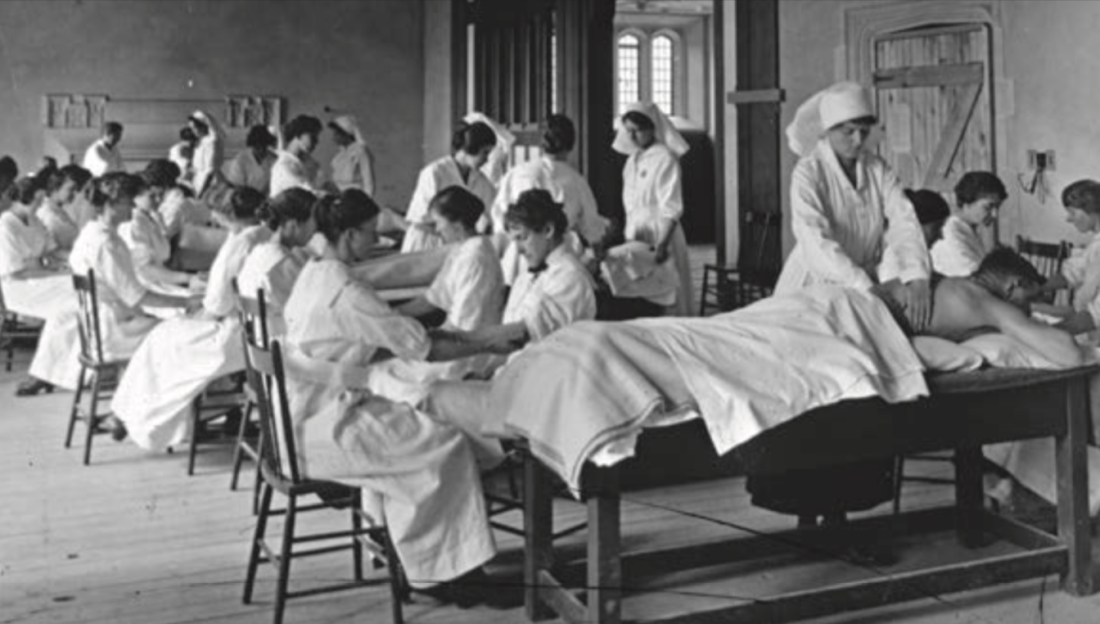
As old as humanity, massage reached its peak or ‘golden age’ in a seventy year period from the late 19th century through to the mid 20th century. Its rise is often attributed to Swede Pehr Henrik Ling, hence the term ‘Swedish Massage’, but it is more reliably attributed to Dutchman Johan Mezger, a gymnast who later became a physician (Goldtsone, 2024). At a time when drugs and surgery were dangerous and unreliable, Mezger provided the medical profession with a safe and effective tool to progress their hegemonic ambitions, whilst concurrently suppressing the lay-competition of Ling’s highly successful Swedish gymnastics (Ottosson, 2016).
The science of massage became a tool of advocacy for the medical profession. English physician Thomas Dowse produced eminent massage texts in 1887 and 1891, whilst US physician Douglas Graham published his massage treatise in 1884; and revised in 1890. The British Medical Journal regularly printed articles on massage from 1884, with eight articles appearing in just the first half of 1886 (Wicksteed, 1948).
Nevertheless physicians were generally reluctant to put their hands on. Instead supporting the creation of a subjugated massage profession – firmly under their control – to actually provide the labour. Women were pleased to take on the work as a reliable and safe opportunity for income (Ottosson, 2016). In due course manuals and treatises were written by nurses and masseuses working within the orthodox medical establishment. The major London hospitals had Massage Departments under the direction of medical staff, and private masseuses were required to follow the directions of physicians if they were to gain patient referrals.
Massage was fast, sometimes furious, and very frequent. In 1889 it was noted that physicians made the mistake of prescribing massage only 2 to 3 time per week, when daily and up to thrice daily massages were necessary to ensure that effects of treatment were not lost before the next treatment applied (Goldstone, 2024). These daily treatments may have occurred for as long as three months. It was long and exhausting work, with the rapidity of the effleurage strokes up to 150 – 360 times per minute.
Massage peaked during and just after the First World War (1914-1918) due to the rehabilitation requirements of the mass casualties. But even at this time new therapies began to erode the predominance of massage, including electrotherapy, hydrotherapy and exercise machines. In the 1920s ultraviolet light became popular, followed in the 1930s by general keep-fit, and in the 1940s integrated rehabilitation and strong exercise. Post Second World War (1939-1945) developments such as proprioceptive neuromuscular facilitation, ultrasound, microwave and manipulation were added to the roster of physical treatments. Massage, whilst never actually disappearing, became a declining part in the armoury of the newly-named, post-war, physiotherapy profession.
The Society of Trained Masseuses
The Society of Trained Masseuses (later the Chartered Society of Physiotherapy) was created in 1894 to regulate the profession of massage in the United Kingdom; and qualifying examinations began in 1895. For most of its history the Society and it successor bodies set an examination paper on Anatomy and Physiology, and a paper on Massage. In 1907, ten of the twelve questions on the Massage Paper related to massage per se. By the late 1930s the inclusion of actual massage questions had declined to about a third as other topics predominated, and by 1945 of the six questions on the Massage paper, none were directly related to the topic of massage (Goldstone, 2024).
A definitive physiotherapy textbook was Tidy’s Massage, first published in 1932, but it mentioned massage only twice in its 413 pages. By the 11th edition in 1986 massage had disappeared completely from the text and in 1991 the book title changed to Tidy’s Physiotherapy. As physiotherapy embraced new technologies and developed as a profession massage became a forgotten subject. In 1964 the decline of massage in contemporary physiotherapy literature was noted,
It was nowhere stated that massage was bad, wrong or ineffective; it merely seemed to have disappeared .. without any cause or reason for it going” (Bell, 1964).
In just over half a century massage had been gradually discarded by the very body of professional people which had formed to protect it (Goldstone, 2024). The tool that once defined a profession and provided it with entrance to health services lost favour as the practitioners sought to professionalise and reduce their own labour. Whilst massage exists today, it is primarily in the form of a complementary medicine.
References
Bell AJ. (1964). Massage and the physiotherapist. Physiotherapy, 50, 406-408.
Goldstone LA. (2024). Essays on massage history 1750-1950. Youcaxton Publications.
Ottosson A. (2016). One history or many herstories? Gender politics and the history of physiotherapy’s origins in the nineteenth and early twentieth-century”. Journal of Women’s History, 296-319.
Wicksteed, J. (1948). The growth of a profession. Edward Arnold & Co: London.
