

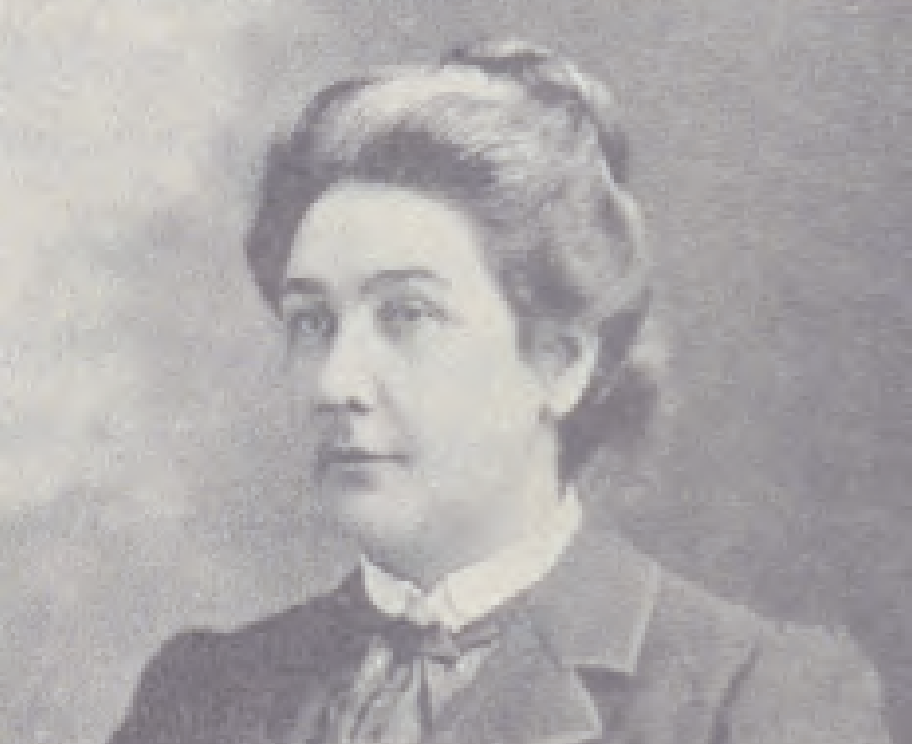
Eliza McAuley was born on 1866 in Upper Plenty, Australia – a rural area just north of Melbourne, Victoria. Her background is unclear, with her father identified both as a farmer (McMeeken, 2016a) and a physician (Bentley & Dunstan, 2006; Forster, 1975). Nevertheless the family fortunes must have been generous as she was educated at Grace Park House, a private college for upper middle-class girls in Hawthorn. The youngest of four children and the third daughter, she followed one of the few paths available to educated women who wanted a career. She was first employed as a governess, then for 10 years with the Melbourne Tramway Company.
A large and physically striking woman – she was six feet tall – McAuley studied massage whilst working for the Tramway Company (Bentley & Dunstan, 2006). Along with Swedish remedial exercises and electrotherapy, massage had become increasingly popular at the time. In 1892, an Australian newspaper promoted the occupation of masseuse in preference to teaching or nursing for young women. The New South Wales Government too recognised the value of physiotherapy and in 1901 provided a two-month course of massage and electrotherapy treatment for soldiers returned from the Boer War.
In 1894, while hunting, Lady Hopetoun, a highly skilled rider, and the wife of Lord Hopetoun, Governor of Victoria, was thrown from her horse. Lady Hopetoun was taken to surgeon, Thomas Fitzgerald’s private hospital, where his examination disclosed a broken nose and damage to the cartilage of the second and third ribs on her left side. Eliza provided her attention as a masseuse and continued to treat Lady Hopetoun, possibly for her later neuralgia. Subsequently Eliza McAuley became the most celebrated female pioneer physiotherapist in Victoria. It was reported that the surgeon Fitzgerald was knighted because he restored Lady Hopetoun’s nose to its pristine beauty (McMeeken, 2016a).
University Level Education
Recognising the importance of a more detailed understanding of the body for her practice, Eliza allegedly approached the then professor of anatomy, Harry Brookes Allen, to gain permission to undertake anatomy studies with two of the female medical students she knew at the University of Melbourne. Her education was informal, as no record of her attendance has been discovered.
Eliza spent two years gaining knowledge of anatomy and in the second year she also went to Melbourne Hospital and attended clinics run by Fitzgerald. McAuley and Maurice Krone were the first physiotherapy honoraries appointed at the Melbourne Hospital in 1899. By 1901, Misses McAuley and Mead, and Messrs Peters and Krone were listed like medical practitioners, as honoraries at the hospital, which was then contemplating establishing a massage school.
Honorary medical staff believed that, apart from its therapeutic value, physiotherapy would assist the more rapid emptying of beds. A formal school did not eventuate at the hospital, but as physiotherapy was obviously necessary McAuley was persuaded to take a few students. She started training others in 1904 (Cosh, 1971) and McAuley’s School of Massage became a nine-month course at the Melbourne Hospital and the University of Melbourne Medical School.
McAuley also had her private practice, which she ran successfully for more than 20 years, at 85 Collins Street in the heart of Melbourne’s medical precinct and near Dr John Springthorpe’s house and consulting rooms. Springthorpe would advocate for physiotherapy’s formal education and become the Australasian Physiotherapy Association’s first president when it was formed in 1906. As a key member of the new association, Eliza sat on the provisional committee appointed to frame the constitution. Her colleague Fitzgerald became patron and she was a member of the first Federal Council.
In 1907 McAuley’s teaching was not a ‘money-making concern’—possibly her private practice provided a good income and she was not paid to teach (McMeeken, 2016b). Nevertheless, her graduates would have aspired to be as successful as McAuley. From 1906 to 1909, McAuley taught students clinical practice at the Melbourne Hospital. She sought more honorary physiotherapists to treat the patients and to teach. The Melbourne Hospital advertised for five masseurs and 10 masseuses, members of the association who would treat patients referred from physicians and surgeons. Each practitioner would give two hours on alternate days, with clinical teachers an additional hour. The Melbourne Hospital’s annual report stated that the hospital and its patients benefited from honorary physiotherapists and ‘large numbers of students are being trained’.
In 1908, as the course progressed, Eliza established a class for eight association members in teaching clinical physiotherapy. Each attendee agreed to devote one year’s work to the hospital and teaching students. In-service preparation of clinical educators, and the establishment of an expectation that clinical physiotherapists would give their time freely to teaching students, became a tradition in physiotherapy education.
The hospital formally appointed Eliza to treat inpatients where her records indicated over 270 patients treated in a year. She also gave dissecting room demonstrations to her students in applied anatomy and kinesiology. As Chief Masseuse of the Massage Department, Eliza reported in the 1908/1909 year 471 patients were treated, 174 inpatients and 297 outpatients. She stated that to optimise physiotherapy’s effectiveness, the Melbourne Hospital required some 40 staff aware of contraindications to treatment, the need to individualise treatment and the importance of gaining patient cooperation. Her honorary staff and 16 students provided 100 treatments each day, working from 2 pm to 8 pm.
Eliza resigned from her position teaching physiotherapy students in 1909 but continued to run her private practice in Collins Street and remained on the Victorian Branch Council of the Australian Massage Association as a strong advocate for educational and clinical practice standards for physiotherapists. During this time period, Eliza had been preparing for the next phase of her life in 1905. Building contractors had completed her ‘splendid residence’ in Healesville, again in rural Victoria, which she named ‘Wildwood’. After 20 years in practice in Collins Street, she ‘retired’ to Wildwood. She ran this large house for paying guests, some of whom appeared to be treated as patients attracted by her clinical reputation. When Alison McArthur Campbell, another eminent physiotherapist, treated the Australian diplomat Alfred Stirling, he told her that as a small boy in 1910 he had been sent to Eliza to stay with her at Healesville in the school holidays, ‘because she took patients there’ (McMeeken, 2016b).
McAuley died at Healesville in 1931 on 23 May 1931. In her will she left real estate valued at £3815 and personal property of £207. Aside from gifts to relatives and friends, she bequeathed a significant portion of her estate to the Society for the Prevention of Cruelty to Children. In the depression times of the early 1930s, her £4000 estate was 27 times the annual wage for female managers and clerks. Her obituary read: ‘Eliza McAuley lived a successful life as a physiotherapist, educator, clinician and businesswoman. She deserves our recognition and respect’.
The Eliza McAuley Memorial Award is an annual prize for the graduating student at each Victorian university who has achieved the highest results in physiotherapy clinical practice. Originally, an anonymous donor provided funds for this prestigious award to provide a perpetual memorial to Eliza, whose foresight and organisation in the days when the profession was in its infancy gave such a sound basis on which physiotherapy education has been built. The prize is ‘awarded to the final-year student who is most outstanding in practical work and the management of patients’.
References
Bentley, P & Dunstan, D. (2006). The path to professionalism: Physiotherapy in Australia to the 1980s. Melbourne: Australian Physiotherapy Association.
Cosh, P. (1971). The challenge of physiotherapy education in Australia. The Australian Journal of Physiotherapy, 17(4), 113-125.
Forster AL. (1975). Physiotherapy – a response to challenge. The Australian Journal of Physiotherapy, 21(4), 125-134
McMeeken J. (2016a). Feeling the way. In Motion, Magazine of the Australian Physiotherapy Association, April, 36-37.
McMeeken J. (2016b). Building physiotherapy education. In Motion, Magazine of the Australian Physiotherapy Association, May, 38-39.
