

The commonly accepted premise of the origins of the physical therapy profession in the United States is that it began in response to the First World War (Hansson & Ottosson, 2015). This understanding has likely arisen from the hegemonic American Physical Therapy Association (APTA) focussing its historical work on its own formation in 1921, and the small amount of alternative historical work. Subsequently the origins of physical therapy, the APTA and the First World War are often conflated.
Whereas older and similarly aged national professional associations — such as the Netherlands (1889), Britain (1894), Australia (1906), Denmark (1918), Canada (1919), Switzerland (1919), New Zealand (1923), and South Africa (1924) — were originally named for their primary services of massage and/or medical gymnastics, only later adopting the title of physiotherapy; the American Physiotherapy Association (later becoming the APTA) was founded and named by demobilised military ‘physiotherapy reconstruction aides.’ Without affiliation and a professional identity, the predecessors of those Army physiotherapy reconstruction aides have slipped from the historical record — their foundational work unacknowledged.
Physical Therapy’s Ancestors
As later entrants to the First World War, the US observed the casualty experience of other nations and prepared with personnel to rehabilitate maimed and wounded soldiers. The military targeted predominantly female physical education teachers, whose knowledge of exercise, anatomy, and physiology made them ideal candidates to be trained as ‘physiotherapy reconstruction aides’ in war emergency courses. Because it is only briefly mentioned in the literature that these proto-physical therapists were already educated in techniques of manual therapy, massage and therapeutic exercise, it is often assumed by the cursory reader that they were relatively blank slates to be written upon. On the contrary, physical education in the United States had previously divided, by common consent, into the educational and the corrective; where the corrective included the,
application of both medical gymnastics and massage to pathological conditions” (Lovett, 1906).
With these extra skills many female physical education graduates were employed as ‘corrective’ assistants in the private offices of orthopaedists and electrotherapy-physicians, where they were expected to be proficient in medical gymnastics and massage (Gritzer & Arluke, 1985; Lovett, 1906).
Swedish Gymnastics
The first six physical education schools from where the reconstruction aides were recruited and where the ‘war emergency courses’ were set up were:
- Reed College (Portland, Oregon),
- Normal School of Gymnastics (Battle Creek, Michigan),
- New Haven Normal School of Gymnastics (New Haven, Connecticut),
- Boston Normal School of Gymnastics (Boston, Massachusetts)
- American School of Physical Education (Boston, Massachusetts), and
- Posse Normal School of Gymnastics (Boston, Massachusetts).
These six schools were specifically chosen. When cross-referencing them with studies on the history of North American physical education, it becomes evident that many, if not all, used Swede Pehr Henrik Ling’s gymnastic system (Hansson & Ottosson, 2015). Ling gymnastics, or Swedish gymnastics as it became known, consisted of three main elements simplistically described as military, pedagogial (physical education) and medical (physiotherapy); with the latter emerging as a major phenomenon in Sweden and across the world throughout the second half of the 19th century (Wanneberg, 2018).
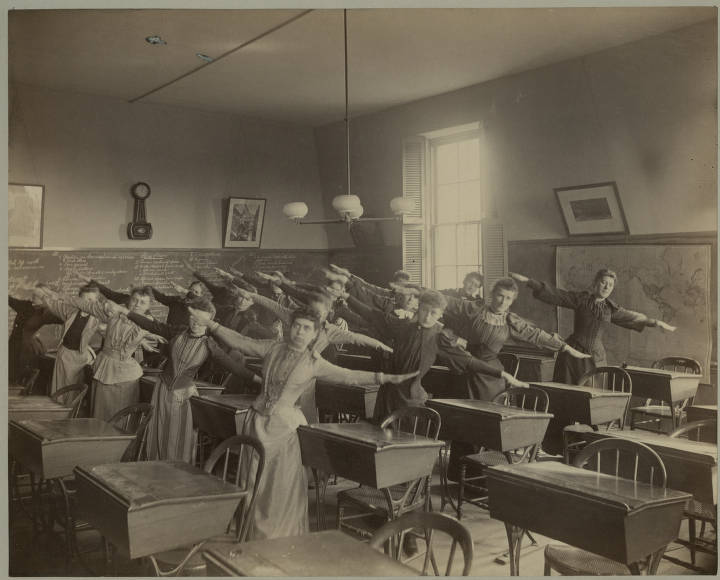
At the closing decade of the 19th century, Ling’s system became the favourite of the Normal Schools training women to become physical educators (Hansson & Ottosson, 2015). Subsequently medical gymnastics or remedial gymnastics was often included in the curriculum.

Teachers-in-training at the Boston Normal School practicing Ling system of gymnastics. Circa 1891-1896.
The Ling system’s greatest promoter in the United States during the 1880s and 1890s, Dr Edward M Hartwell, believed the Swedish Royal Central Institute for Gymnastics (RCIG) produced the best physical educators in the world because its students were trained to also handle children not fit enough for the gymnasium (Hansson & Ottosson, 2015). Subsequently the reconstruction aides coming from these Normal Schools did not need to be taught much in their military course. To physical educators trained with Ling’s system, working with sick bodies was not alien.
The connection between Ling and two of the schools is even stronger. The Boston Normal School of Gymnastics brought the RCIG alumnus Baron and Lieutenant Nils Posse, sometimes referred to as the “Father of Swedish Gymnastics” in the US, to the school (Hansson & Ottosson, 2015). Later Posse formed his own school, called Posse Normal School of Gymnastics.
A graduate of the Boston Normal School of Gymnastics was Marguerite Sanderson. She worked in the office of orthopaedic surgeon Dr Joel Goldthwait, providing corrective exercises to his patients (McCullick & Lomax, 2000). Recognising her skillset, Sanderson was the first physiotherapy reconstruction aide recruit and was sent by the Army to Walter Reed General Hospital in Washington, DC, in 1917, to train and organise units of the Reconstruction Aide Corps.
Connections between the Ling system and the reconstruction aides also existed outside of the Normal Schools. Sanderson was joined at Walter Reed General Hospital by the second recruit, Mary McMillan, who soon took her place when Sanderson left for Europe to inspect her first group of trainees. Although American born, McMillan was raised and educated in England, where she had completed a two year course in physical culture and corrective exercises, including Swedish gymnastics, and undertaken further courses in neuroanatomy, neurology and psychology (McMillan, 1960). Post-war McMillan was a founder and first President of the American Physiotherapy Association. Anointed the ‘Mother of Physical Therapy in the Army’ (Moffat, 2003), in her most influential publication Massage and Therapeutic Exercise, McMillan states that it is to,
Peter (sic) Henry Ling and Swedish systemized order that we owe much today . . . in the field of medical gymnastics or therapeutic exercise.”
A final example, but surely not the last, connecting Ling’s system and the reconstruction aides was Inga Lohne Brauner, who was originally from Norway. She attended teachers college at Columbia University, and in 1915 and 1916 visited gymnasiums in Scandinavia and Europe, where she was likely well-exposed to the Ling system (Moffat, 2003). Lohne returned to America and was the third reconstruction aide, after McMillan, to report for duty. Post-war Lohne taught at the Boston Normal School of Gymnastics and became the second President of the American Physiotherapy Association.
Conclusion
Further research is required but based on this review, it is clear that the proto-physical therapists of the US were trained and experienced in exercise therapy and massage, courtesy of the Swedish Ling system. Therefore they were technically capable of opening physical therapy clinics before the war (Gritzer & Arluke, 1985) and were well placed to take on their new role of physiotherapy reconstruction aides for the military. Most importantly their practise, up to forty years prior to the formation of the American Physiotherapy Association adds new depth to the history of the profession in the United States and provides a common ancestry.
References
Gritzer, G & Arluke A. (1985). The making of rehabilitation: A political economy of medical specialisation, 1890-1980. University of California Press: Berkley.
Hansson N & Ottosson A. (2015). Nobel Prize for Physical Therapy? Rise, Fall, and Revival of MedicoMechanical Institutes. Physical Therapy, 95(8), 1184-1194.
Lovett, RW. (1906). Corrective work in physical education as an occupation for women. American Physical Education Review, 11(4), 250-257
McCullick BA & Lomax M. (2000). The Boston Normal School of Gymnastics: An unheralded legacy. Quest, 52(1), 49–59.
McMillan M. (1960). Physical therapy on three continents. The Physical Therapy Review, 40(2), 140 – 143.
Moffat, M. (2003). The History of Physical Therapy Practice in the United States. Journal of Physical Therapy Education, 17(3), 15–25.
Wanneberg PL. (2018). Gymnastics as a remedy: A study of nineteenth century Swedish medical gymnastics. Athens Journal of Sports, 5(1), 33-52.
