

As an adjunct health service or a junior partner to medicine, massage has oft lacked respect. So much so, that even its own history has remained poorly understood. Massage needed someone to come along to provide intellectual rigour to its story, and it came in an unlikely form – a retired English professor of applied statistics, Leonard Goldstone. Armed with an insatiable curiosity and a quality research skillset, Professor Goldstone has produced a series of essays that lay down the irrefutable history of significant Western masseuses, masseurs and massage.
The essays on massage history stand, and can be read, independently or in any order of interest; although they do follow a historical order. Context is provided with precursors in ancient China, India, Greece and Rome identified. The Renaissance to the 19th century is covered with emphasis on the golden age of the mid to late 1800s, when both eminent medical practitioners and non-physicians figured large in writings. The essays also cover the importance of the First World War and the formation of a new profession called physiotherapy. In addition they discuss some controversial areas such as who created ‘Swedish Massage’; who were the first writers on medical audit; what was Florence Nightingale’s role in massage history; who were the foremost authorities on massage; and whose names have been almost erased from history.
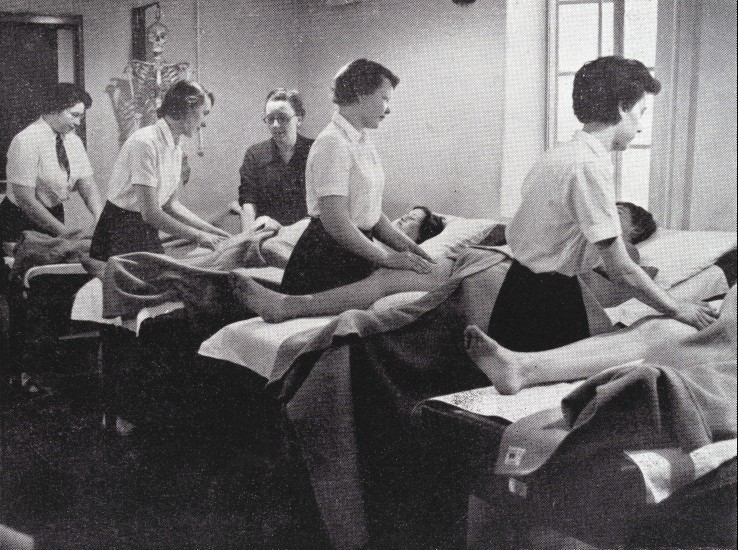
The 1950s is considered an end point for massage. Physiotherapy had taken over the practice and then abandoned it when medical solutions became available for many conditions, electrotherapy allowed for greater economies of scale, professional progression required broader study and the newly formed NHS in the UK became more prescriptive.
The book concludes on a very human level with an essay profiling the work of a man who designated himself as a masseur up until the 1960s, long after most former ‘masseurs’ had become ‘physiotherapists’ – making him possibly the last ‘masseur’ in England at that time.
The book ‘Essays on Massage History 1750 – 1950’ (ISBN: 9781915972101) was published in 2024 by Youcaxton Publications. It is a delightful read, full of interesting stories and revelations. And with the detailed research undertaken to inform the stories, it will likely become an authority text on the history of massage, and offer a world of opportunity for future researchers to re-assess.
The Author
Professor Goldstone’s personal interest in massage began later in his career. Lecturing to post graduate nurses at the University of Durham he became aware of short massage courses that they were attending. His wife (a nurse herself) completed the course and after practicing on him, expressed a wish to be on the receiving end one time, so suggested he might do the same course. During his massage education he noted contradictory narratives and erroneous canons of massage history, and sought to do something about.
The timing was right; when working as Dean at London South Bank University he began a personal crusade to explore the libraries and hospital archives of London, so as to better understand the history of massage. He has also collected over 1,400 books on massage to form his own library. In his retirement Professor Goldstone has lectured extensively on the history of massage at universities, at conferences and for societies. Stimulated by enthusiastic students he sought to write all the information he had collected into a single book.
Professor Goldstone is currently working on the history of massage in the Bible – the Old Testament of the Jewish and Christian faiths. Currently living in Israel he is exploring the history of ancient Roman bath houses and the kosher behaviours allowed within.
