

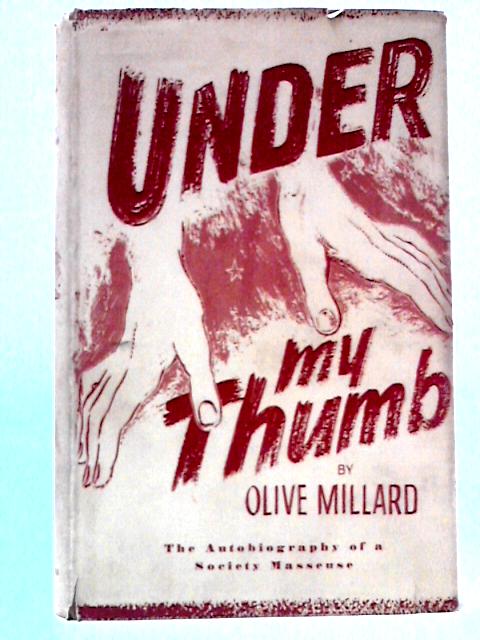
It is rare to find physiotherapists writing about their experiences (Nicholls, 2021), which makes Olive Millard’s (1952) autobiography Under My Thumb so important. A summary of Millard’s professional career is written by Goldstone (2024) and is further summarised here:
Becoming a Physiotherapist
Raised in Yorkshire, UK, Millard studied Art at the University of Leeds where she specialised in machine-made lace. Her first job was as an au pair in Germany in 1911. In that role she was to accompany and mentor her client’s 15-year-old daughter, Margot – to bring her ‘out’ into the society of the day. The young lady had a spinal problem and also received daily treatment by ‘Andrea’, a Swedish trained masseuse. Andrea was self-employed, drove her own car, had a large clientele, and ran her own gymnasium where she worked on ‘correcting deformities and making the weak strong’. Andrea’s autonomy made a marked impression on Millard.
Millard also cared for Margot’s younger brother Odo, who suffered from rickets. Millard spent months with the child at a sanatorium and, inspired by Andrea’s career, began her own training in massage and gymnastics. She studied at the sanatorium and practiced the techniques daily on Odo.
In 1914 Britain declared war on Germany so Millard returned to the UK where she found work in a hospital. At the same time she studied for the qualification granted by the Incorporated Society of Trained Masseuses (later the Chartered Society of Physiotherapy) at the London Ladies College.
As a student, whilst working at King George’s Hospital in London, Millard had the opportunity to study gunshot woulds and their effect on the nervous system. Clinical practice took her to Harley Street where she attended the patients of leading physicians and was exposed to the new ionisation treatment. At the other end of the social scale she worked in the family and children’s wards of Marylebone Infirmary, amongst the squalid and depressing sick of London slum life.
First World War
In 1916 Millard achieved her membership of the Incorporated Society of Trained Masseuses and began working in a Red Cross Auxiliary Hospital in Brighton. Millard’s work took place in large private houses converted by their owners into hospitals. One location was nicknamed the ‘Straffe-haus’ (Punishment house) due to the supposed rigorous treatment given to patients by massage, electrical treatments and muscle testing. The massage staff consisted of three men (‘for the heavier work’) and seven women, who between them, dealt with 130 cases daily.
At the start of 1918 the British Army recognised the value of physiotherapy and merged the Red Cross units into the army, meaning for the masseuses their pay was reduced and stricter discipline, rules and regulations were imposed. Millard gave a week’s notice and was discharged.
Millard then moved to the Military Hospital at Leeds to join a team of eighty. Each masseuse did an average of 110 treatments per week, of which around 100 were ulnar nerve injuries. By this time treatments included electrical muscle testing – using Galvanic and Faradic currents. In addition, the new techniques of skin grafting for facial injuries took place and Millard was steeped in this. Also melted paraffin wax was seen to be beneficial as a preliminary to the massage of swollen and stiff joints.
Millard moved to Gloucester Royal Infirmary in charge of the physiotherapy department, and began working with civilians. At this time her own health suffered, requiring a three month period of personal convalescence.
Private Practice
Millard returned to hospital, military and elderly care work but was encouraged by a neurology specialist to set up her own London practice. As it began to flourish the hospital work had to be given up. Then followed a career of private working between London and fashionable European resorts, to which she would accompany patients doing freelance work.
The private work could involve commissions to accompany wealth patients needing daily massage. This left her much leisure time. Some of this was spent at famous clinics to study their methods of treatment, eg., the pioneering sun ray treatment in curative work for tuberculosis and malnutrition. In exchange for being introduced to the new techniques Millard assisted with the care of English-speaking patients.
Some of the examples of her commissions included tending to a family of three victims of a motor vehicle accident where the father had a fractured elbow, his wife shoulder and facial injuries, and their son a strained spine. Another was to accompany and treat an eminent doctor whilst in Monte Carlo, overlooking the Mediterranean. She also accompanied an elderly wealthy man to his Irish estate for six weeks. Her duties consisted of an hour’s treatment in the morning and evening. The remainder of the time she spent playing golf on the course adjoining the manor. Much time was spent on patient’s luxurious yachts for cruises, where social life was paramount. Millard attended events with the most wealthy people in British society, aristocrats, as well as the King and Queen.
Whilst back in London Millard attended the important, wealthy and privileged, including peers and international ballerinas, whose ankles and thigh muscles she described ‘as hard as iron’. Millard developed a regular routine of travel between Monte Carlo and London for seventeen years, often attending to the same people. Whilst in Monte Carlo she made as many as twelve visits per day, usually to hotels. To fund travel to and from Monte Carlo she would escort patients in both directions thereby absolving herself of the costs.
In 1932 Millard returned to Germany; her first day coincided with the election to Chancellor of Adolf Hitler. It was a working holiday, as 65% of her expenses were paid for touring spas of the Rhine and writing up treatments for newspaper articles to promote the tourist trade. During this time she herself suffered a serious illness and surgery requiring a 3-month rehabilitation period in a German convent hospital. She wrote up the episode for an article in the British magazine, Nursing Mirror. As late as 1951 Millard was still visiting European spas and experiencing a range of treatments.
Within these adventures Millard was constantly being exposed to new treatments including medical electricity, vibrations, the treatment of scars by suction cupping and trigger point therapy. She was also the physiotherapist to major industrial company ICI, attending their headquarters regularly to treating fractures, accident injuries and rheumatism. As in most of her other work she attended to the needs of many captains of industry, and used the connections to provide further opportunities.
Conclusion
Inspired by the autonomy of Swedish masseuse ‘Andrea’, Millard used physiotherapy to achieve a life not available to most women of the time. She wrung every opportunity to progress to the next, and lived an extraordinary life.
References
Goldstone LA. (2024). Essays on massage history 1750-1950. Youcaxton Publications.
Millard O. (1952). Under my thumb. London, Christopher Johnson.
Nicholls DA. (2021). Physical Therapy’s Hidden History. Physical Therapy and Rehabilitation Journal: Physiotherapy, 101, 1-2.
