

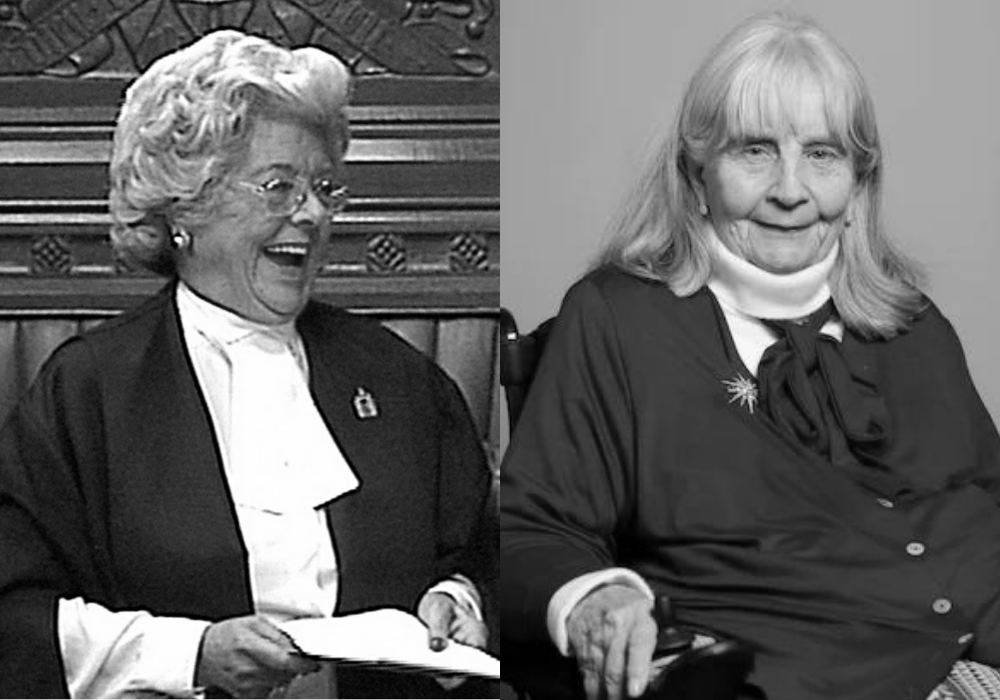
Baroness Boothroyd and Baroness Masham who both died during the early months of this year were unique and great women who achieved and gave so much to Chartered Society of Physiotherapy (CSP). The CSP was fortunate to benefit from their commitment, expertise and advocacy as Presidents and figureheads.
Baroness Boothroyd of Sandwell – CSP President 1996 to 2001
Betty Boothroyd was born in Dewsbury in the West Riding of Yorkshire on 8 October 1929. She came from a modest background as the daughter of textile workers and attended State schools, going on to study at Dewsbury College of Commerce and Art.
Betty was unique in being elected as Speaker of the UK House of Commons in 1992 and served in that role until 2000. She was the first, and to date the only woman to serve as Speaker of the House of Commons. Betty was elected as a Member of Parliament for the safe Labour seat of West Bromwich in 1973, having previously stood for election unsuccessfully in four other constituencies around the country.
On standing down from the role of Speaker, Betty was elevated to the House of Lords becoming the Baroness Boothroyd of Sandwell. Being elected by her fellow parliamentarians to the office of Speaker of the House of Commons was not her only first as a woman as she became the first woman Chancellor of the Open University from 1994 to 2006.
CSP Presidency
In 1995, CSP Council were seeking a new President to replace the previous incumbent Baroness Robson of Kidlington who was retiring from the role. Council had clearly indicated that a high-profile figure in the public (preferably political arena) with a deep interest and commitment to advocating for physiotherapy and committed to forwarding the interests and work of the profession would be ideal. During that year, with Council approval I approached my old school friend with whom I had kept in good contact over the years, David Blunkett MP (later Lord Blunkett), with a view to “sounding” her out about the possibility of becoming our President. We were delighted when she quickly and enthusiastically indicated that she would be very pleased to accept the Presidency if the CSP were minded to formally invite her. Following a meeting with Betty about the role of CSP President, a formal invitation was made and the rest is history. Betty Boothroyd MP became President of the CSP in 1996 during my term of office as CSP Vice-Chair and continued through my chairmanship, stepping down from the role in 2000.
As President, Betty worked hard for physiotherapy, advocating for the Profession particularly behind the scenes with Parliamentary colleagues. She undertook the CSP presidential roles enthusiastically and warmly including attendance at the Annual General Meetings, the presentation of CSP Fellowships and her Presidential speech. Betty had a great sense of humour and had a wonderful down to earth common-sense approach; she was fun-loving and was greatly respected and admired by all those CSP members with whom she worked and came into contact. She was a very warm person with a deep interest in the work of physiotherapy.
I recall her explaining to me that as a young woman her dream was to go on the stage and she did become a member of the famous Tiller Girls Dance Troupe. Clearly her ambition to perform on the stage in public stood her in good stead for many of her future roles.
Baroness Masham of Ilton and Dowager Countess of Swinton – CSP President 1975 to 1982
Lady Masham was born Susan Lillian Primrose Sinclair in Caithness, Scotland on 14 April 1935. In 1958, she sustained triple fractures of her spine in a riding accident when she was 22 years old, resulting in her becoming paraplegic. On her admittance to Stoke Mandeville Hospital following the accident a doctor apparently said that even if she lived through the night she would never move again. However, after nine months physiotherapy under the care of the world renowned Sir Ludwig Guttmann and his team some movement was restored. Even though paralysed from the chest down she led a very full and active life as a Paralympian and champion for many important causes.
As a Paralympian she represented the UK In the 1960 (Rome) 1964 (Tokyo) and 1968 (Tel Aviv) Paralympics. Her sports were swimming and table tennis and during her paralympic career she won a gold and four silver medals in swimming and a gold, two silver and two bronze medals in table tennis. Amazingly, in the Rome Games the Italian army were called upon to carry the 400 paralympians in their wheelchairs up to the paralympic village which was built on stilts.
At the age of 35, in 1970 she entered the House of Lords becoming the youngest Life peer up to that time. As a member of the House of Lords Baroness Masham championed many important causes, for example, promoting parliamentary Bills obliging riders to wear protective headgear, fought the means testing of disability benefits and as an enthusiastic motorist she advocated for the rights of disabled drivers.
Lady Masham advocated very strongly that disabled people had needs which must be acknowledged and addressed, for example, being able to get into and out of one’s house and public buildings, transport, have enough money to live on and to access toilets. Apparently she let it be known that the most infuriating building for wheelchair users to access was the European Commission building in Brussels where every toilet door was too narrow for a wheelchair.
Lady Masham founded the Spinal Injuries Association in 1975 and served as its President from 1982. Together with three other peers in the House of Lords she helped to steer the 1970 Chronic Sick and Disabled Persons Act through Parliament.
When health authority plans to cut the number of beds at the Stoke Mandeville Spinal Unit were proposed, Lady Masham was incensed and joined forces with Sir Ludwig Guttmann to secure a reprieve for the Unit so that levels of accommodation and rehabilitation continued unchanged.
Lady Masham’s involvement and commitment to public life particularly in the realms of health care, disability and welfare were wide ranging and diverse and she worked tirelessly to improve opportunities, facilities and full equality and belonging in society for people with disabilities and health problems.
As well as being an extremely committed energetic and distinguished President of the Chartered Society of Physiotherapy from 1975 to 1982 she continued to serve as a Vice-President for some years when her term as President concluded. The list of her roles is impressive to say the least. The many organisations and causes she served included for example: Yorkshire Association for the Disabled, Vice-President of British Sports Association for the Disabled, British Disabled Drivers Trust, the Association of Occupational Therapists and Action for Dysphasic Adults.
