

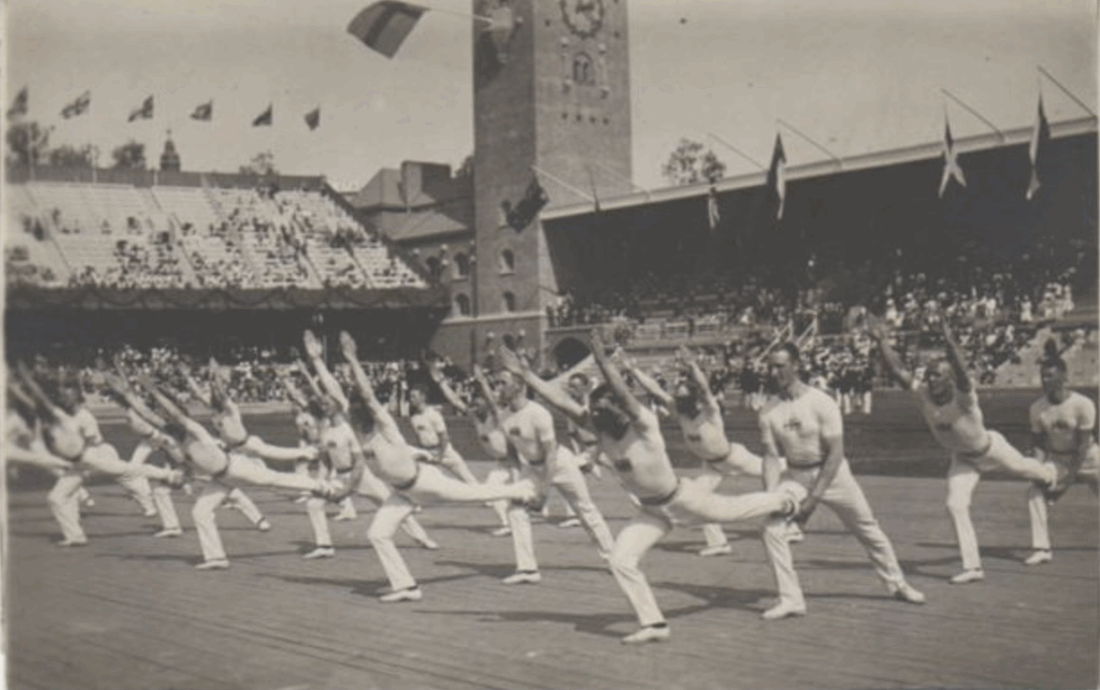
The Swedish gymnastics of Pehr Henrik Ling consisted of four branches: military (fencing), medical (physiotherapy), pedagogical (physical education) and aesthetic (dance). For the latter two, the system emphasised floor exercises along with “Swedish bars” (attached to a wall), balance beam, vaulting box and some hand-held apparatus. The movements were generally rhythmical and free-flowing, and aimed to strengthen all of the body’s parts.
A clear line can be drawn from Ling’s Swedish gymnastics to the current men’s and women’s floor exercises, and the balance beam of women’s gymnastics. Similarly, the practice of Swedish gymnastics in female physical education colleges and institutions, especially when combined with music and dance, can be seen as the antecedent of the sports of rhythmic gymnastics and aerobic gymnastics. The evolution of gymnastic exercises has been outlined by Keith Russel (2013) when he explored the history of gymnastics in the Olympics.
Olympic Gymnastics
From the very beginning of the Olympic Games there was considerable debate regarding the virtues of the German versus the Swedish styles of gymnastics, and both of them versus the English sports approach in education. Pierre Frédy, Baron de Coubertin, the father of the modern Olympic Games, believed the German style of gymnastics was superior to the more medically oriented Swedish system,
… German gymnastics … is energetic in its movement, based on strict discipline and, in a word, military in its essence.”
Thus, we see in the first IOC Olympic Games in Athens in 1896 the inclusion of the German gymnastics apparatus of horizontal bar, parallel bars, pommelled horse, rings, horse vault and rope climb. In the Paris Olympics of 1900, the gymnastics competition consisted of 16 different types of apparatus including the same apparatus used in the 1896 Olympics, plus freestanding exercise, pole climb, combined jumps (high jump, long jump, pole vault), and a weight lifting competition.
The battle between the Swedish and German styles played out in the next several Olympics with some interesting twists and turns. In the 1904 St Louis Olympics, there were actually two separate gymnastics competitions held several months apart. The Turnverein (German) competition was held first and then four months later the Swedish gymnastics competition.
In the 1908 London Olympics athletes had to compete on seven (heptathlon) apparatus: (1) horizontal bar, swinging; (2) horizontal bar, slow movements; (3) parallel bars; (4) rings, stationary; (5) rings, swinging; (6) pommelled horse; and (7) rope climb. There was also, however, a Swedish-style team mass exercise competition of 16–40 competitors doing free exercise or exercises with hand apparatus with a maximum time limit of 30 minutes.
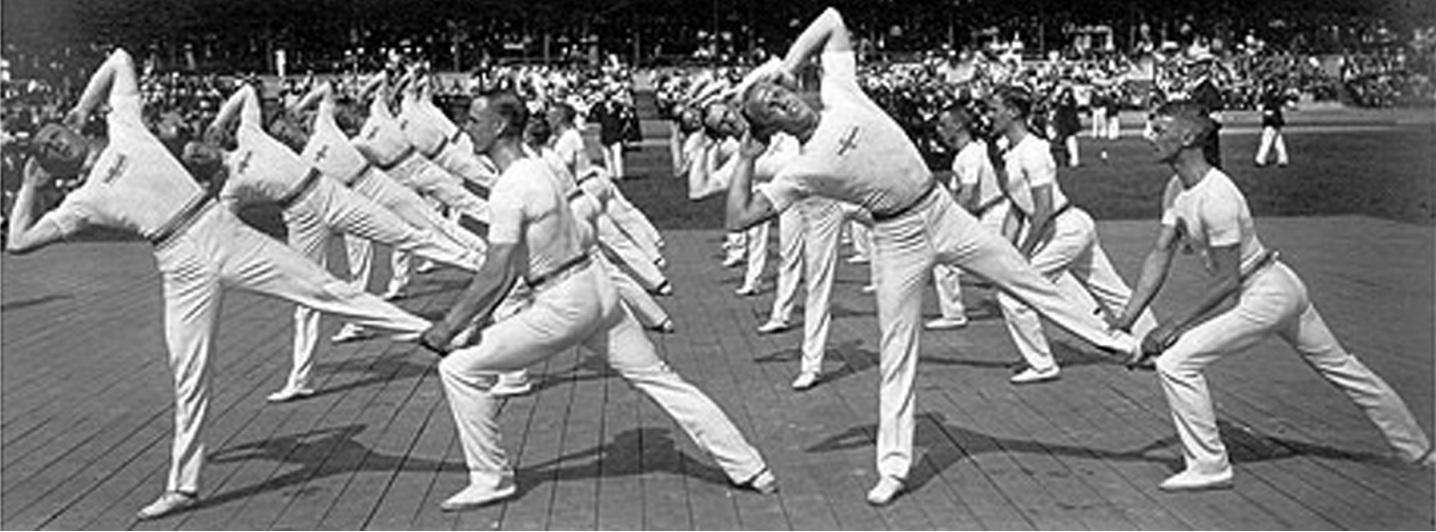
Scandinavian style group gymnastics.
In 1912 in Copenhagen and again in 1920 in Antwerp, there were only the four German gymnastics apparatuses of horizontal bar, parallel bars, still rings, and pommelled horse, but there were also three separate team competitions. One was the apparatus team competition, another was the Swedish gymnastics team competition, and the third was a free team competition.
The 1924 games in Paris saw routines performed on the same four apparatuses used in the previous two Olympics plus voluntary skills on rope climb, side horse vault (no pommels), and long horse vault (interestingly by vaulting over a high jump bar before contacting the horse). A group “drill” routine was added into the team total.
In Amsterdam in 1928, rope climb was deleted and routines were performed on the same four apparatuses as in the previous years plus the pommel horse vault. This was the first Olympics in which women officially competed even though there had been women’s gymnastics group exhibitions in most of the former Olympics.
Women did not compete in gymnastics in the 1932 Olympics in Los Angeles. All apparatuses were awarded medals including the Indian clubs, rope climb, tumbling, and individual freehanded exercise. The latter was Swedish-style calisthenics without hand apparatus, thus “freehanded,” and was to become one of the six permanent apparatuses in subsequent Olympic competitions; now known as floor exercise.
The Berlin 1936 Olympics saw the standardisation of the men’s apparatus to the current six: (1) floor exercise, (2) pommel horse, (3) rings, (4) vault, (5) parallel bars, and (6) horizontal bar. The women competed on individual apparatus for the first time, even though only a team score was awarded medals. They also competed in two group routines, with and without ‘portable’ (hand) apparatus.
In the 1948 London Olympics, the men’s apparatuses were the same as in Berlin 1936 Olympics. The women’s apparatus included swinging rings, balance beam and pommelled side horse vault plus two group routines, one with and one without hand apparatus.
The 1952 Helsinki Olympics program included the six contemporary apparatuses for men and the four contemporary apparatuses for women. The women also competed on an optional routine in the Swedish-style gymnastics group competition with hand apparatus.
The exact same apparatuses were contested in the 1956 Melbourne Olympics, and subsequent Olympics, but Melbourne would be the last time, under the banner of Artistic Gymnastics, that the women would compete in a Swedish-style group competition with hand apparatus.
The Swedish-influenced group gymnastics and gymnastics with hand apparatus continued to evolve, and were strongly influenced by modern dance as well as by the Rhythmic Gymnastics styles evolving in the Soviet Union, Finland, and Estonia.
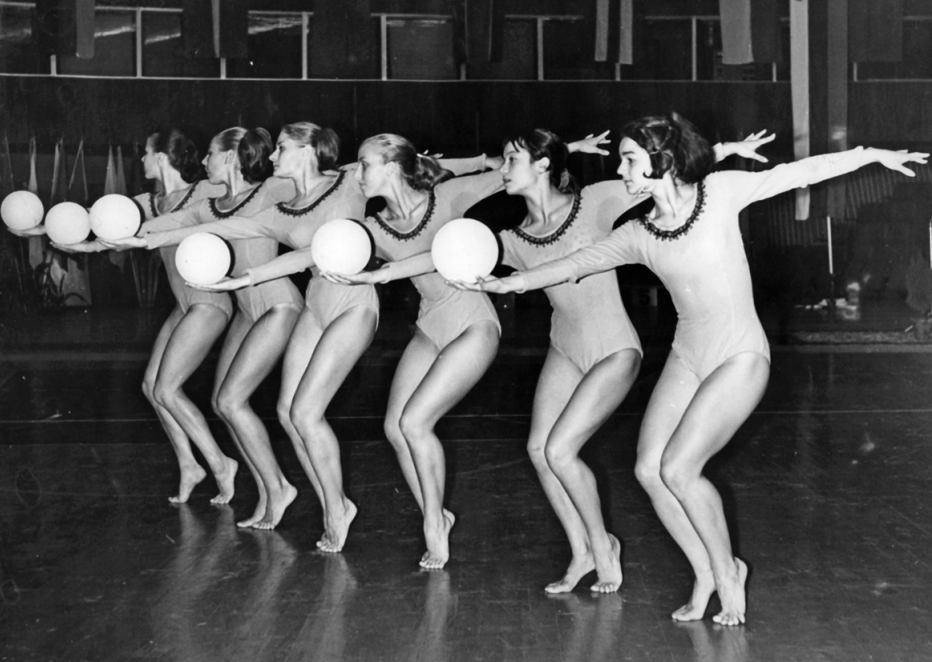
The sport of modern gymnastics came under International Gymnastics Federation umbrella in 1961 and changed its name to Rhythmic Sportive Gymnastics and had its first world championship in 1963. It was then “reintroduced” into Olympic competition in the 1984 Los Angeles Olympics as the sport of Rhythmic Gymnastics.
Conclusion
A clear line, through the lens of the Olympic Games, has been traced from Swedish gymnastics to the modern floor and beam competitions of artistic gymnastics and the sport of rhythmic gymnastics. Subsequently the legacy of Pehr Henrik Ling, who so strongly influenced the professions of physiotherapy and physical education, continues to expand.
References
Russel K. (2013), The evolution of gymnastics. In Caine DJ, Russel K & Lim L (Eds). Handbook of Sports Medicine and Science Gymnastics, p3-16. Wiley-Blackwell: Oxford.
