

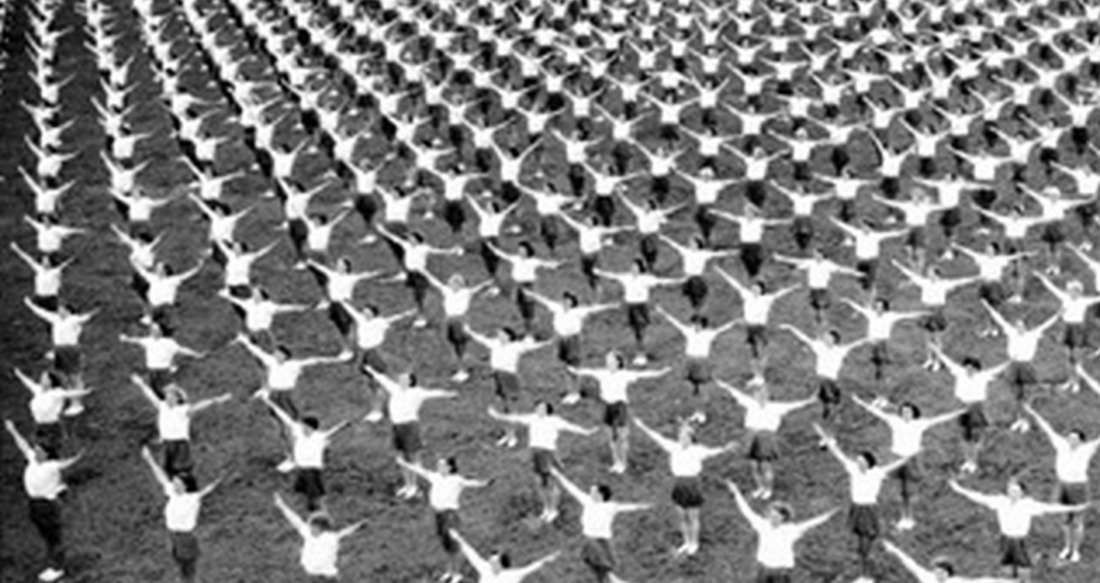
An international gymnastics display, with 7,399 participants from twelve countries, was held in Stockholm in 1939 to commemorate the centenary of the death of Per Henrik Ling (1776–1839), the founder of Ling gymnastics (Meckbach & Lundquist Wanneberg, 2011). The ‘Lingiad’ enabled the participants to experience a celebration comparable to the Olympic Games, however where the Olympic Games were—and still are—based on competition aimed at the elite in every form of sport, the Lingiad was based on non-competitive display. In both form and idea, the Lingiad was Ling gymnastics and its’ objectives related to physical exercise for everyone, and not just the best.
At that time, sport was regarded as a phenomenon that was separate from gymnastics, ie., it stood for something different and abnormal—something that did not follow the norms or ideals of physical education. Advocates of Ling gymnastics, which required physiologically correct and sensible exercises, and collective participation distanced themselves from the emerging Anglo-Saxon sport. The collective practice of gymnastics promoted health, control, and precision, while sport was aimed at developing individuality.
Advocating for attendance at the second Lingiad in 1949, Phillip Smithells (1949), Director of the School of Physical Education, University of Otago, New Zealand said of the first Lingiad,
I think it would be fair to say that never in the whole history of the world have so many healthy, purposeful, and striking-looking young people been assembled in such beautiful surroundings as at the Lingiad in 1939.
Ling Gymnastics, a Swedish Export Product
Different forms of kinetic culture were developed in Europe at the beginning of the nineteenth century. Ling gymnastics was one of these cultures, and ‘Turnen’ in Germany another. Ling gymnastics has been described as one of Sweden’s biggest cultural export products. The Royal Central Institute of Gymnastics (RCIG) in Stockholm, founded in 1813 with the aim of developing Ling gymnastics, started to send gymnasts abroad as early as the 1830s, and, by the turn of the twentieth century, was admitting foreign students to its courses.
By the beginning of the twentieth century, Ling gymnastics had become popular in many different countries, and especially in Sweden among researchers and teachers at the RCIG, health practitioners, and physical education teachers in schools. The educated public also regarded Ling gymnastics as superior to other forms of physical exercise. Ling gymnastics gained a foothold in schools in a number of other countries, such as Denmark, Norway, England, Belgium, Portugal, and the USA. Its popularity was helped by the fact that Ling gymnastics was legitimised by physiological principles supported by medical discourses.
The Aims and Development of Ling Gymnastics
The aim of Ling gymnastics was, with the aid of specially designed movements, to exercise the body in as balanced and holistically harmonious a way as possible. This also applied to the body’s internal organs and inner soul. The idea of holistic harmoniousness originated from Per Henrik Ling’s understanding of the philosophy of nature that everything was interconnected. As individuals consisted of a number of different parts, they could not be regarded as completely whole. Rather, wholeness was dependent on how the different parts related to each other. In short, it was thought that harmony led to good health, while disharmony created ill-health.
Alongside Ling gymnastics, which, in Sweden, was mainly practised in the public sphere (eg., at the RCIG, in schools, and in the military), a voluntary kind of gymnastics—in gymnastics clubs—developed in parallel to the growing sports movement at the end of the nineteenth century. The gymnastic forms practised here, for which the Swedish Gymnastics Federation eventually assumed responsibility, were developed to include both males and females, although separately.
The Swedish Gymnastics Federation agreed with the Ling gymnasts’ view of competition and regarded the simple and everyday exercise programme as the most important. However, club gymnastics continued to be developed and several forms of gymnastics existed side by side: school gymnastics, children’s gymnastics, and female and male fitness gymnastics. Individual competitive gymnastics and team gymnastics also developed as alternative forms.
World Gymnaestrada
Gymnastics festivals are not solely a Swedish phenomenon. The first known gymnastics festival was held in 1832 in Aarau, Switzerland. At the beginning of the twentieth century, national gymnastics festivals were also organised in Norway, Austria, Germany, and Switzerland, and most of them invited foreign guests.
The 1939 Lingiad was an international gymnastics festival that attracted several thousand participants from twelve countries. When the event was repeated ten years later, in 1949, it attracted more than 14,000 participants from fourteen countries. The Fédération Internationale de Gymnastique (FIG) also decided to arrange its congress in conjunction with the 1949 Lingiad. Inspired by the event, Dutch delegate Johannes Heinrich Francois Sommer introduced the idea of a recurring international gymnastics festival. This idea was approved, and, one year later, at the meeting in Basel, Sommer introduced both his idea and its name— the World Gymnaestrada. Sommer proposed that the name be based on Gymna-, which comes from the word gymnastics; Estrad-, the word for the stage/tribune for recreational sport; and Strada-, which stood for the long road that was already laid down by the gymnastics clubs and was still being followed.
The first World Gymnaestrada organised by the FIG was held in Rotterdam in 1953 with 5,000 gymnasts from fourteen different countries. Since then, the World Gymnaestrada has been held every four years and it is the only worldwide ‘Gymnastics for All’ event. Event participation is open to all genders, ages, races, religions, cultures, abilities, and social standings. Peak participation occurred in 2003 with 25,000 participants in Lisbon, Portugal.
A number of elements from Ling gymnastics can be discerned in the ‘Gymnastics for All’ concepts, and they also permeate the World Gymnaestrada. ‘Gymnastics for All’ is a separate form of gymnastics within the international gymnastics family, which also includes men’s artistic, women’s artistic, rhythmic, trampoline, aerobic, and acrobatic. ‘Gymnastics for All’ activities contribute to personal health, fitness and well being – physical, social, intellectual and psychological. It can be performed with or without apparatus, gymnastics, and dance. ‘Gymnastics for All’ offers aesthetic experiences in movement for participants and spectators while providing the opportunity to focus on items that are of particular interest in a national and cultural context. Both ‘Gymnastics for All’ and Ling gymnastics emphasise the accessible nature of gymnastics, in that it is designed to promote the health of the population as a whole, and it can bring participants together from different countries in order to build bridges and learn from each other.
References
Meckbach J & Lundquist Wanneberg P. (2011). The world gymnaestrada – a non-competitive event: The concept ‘gymnastics for all’ from the perspective of Ling gymnastics. Scandinavian Sport Studies Forum, 2, 99-118.
Smithells FP. (1949). Going to the Lingiad? Journal of the American Association for Health, Physical Education, and Recreation, 20(2), 94-94
