

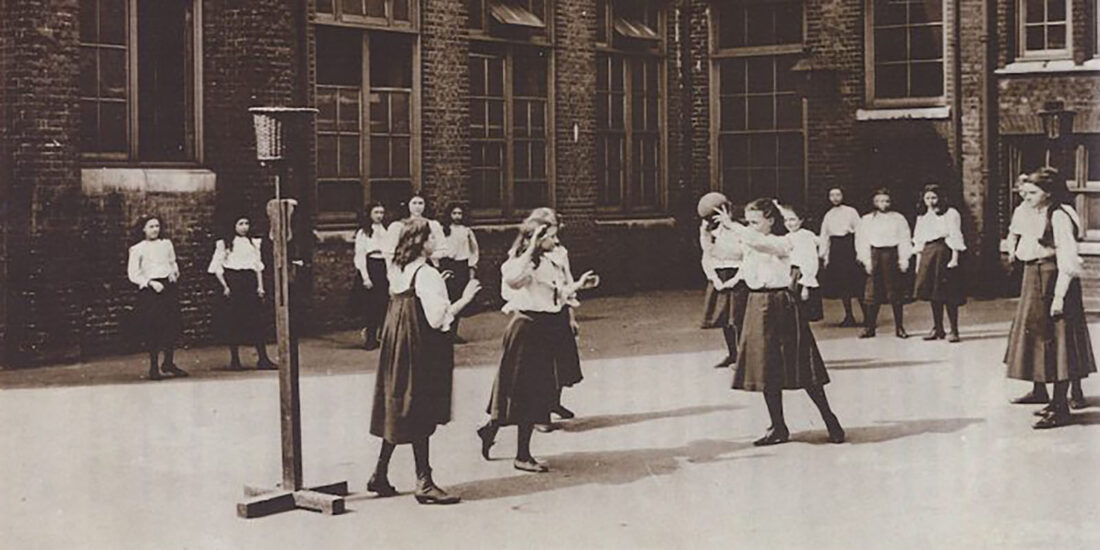
The international game of netball can trace its popularity and codification to a unique college of Swedish gymnastics in the United Kingdom at the turn of the nineteenth century. The all-female college was also at the heart of the development of both the physical education and physiotherapy professions.
Women’s Basketball
In 1891 in Springfield, Massachusetts a 30-year-old Canadian immigrant to the USA, James Naismith, invented a new indoor game for young men at the School for Christian Workers (later the YMCA). Most games played by high-spirited young men produced significant injury rates, so Naismith conjured up a game whereby a ball had to be lobbed into a high peach basket. His reasoning being that if a ball had to dropped into the ‘goal’, it couldn’t be thrown at breakneck speed.
Initially the game had nine players on each team – three guards, three centres and three forwards. This was based solely on Naismith having eighteen boys to keep occupied.
Basketball was a success and four years later Clara Baer, a sports teacher in New Orleans, wrote to Naismith asking for a copy of the rules. The package she received contained a drawing of the court with further lines penciled across it, to show the areas various players could best patrol. Baer misinterpreted the lines and thought players couldn’t leave those areas and were to remain in their zones. Netball or ‘women’s basketball’ as it was known was born.
Women’s basketball soon crossed the Atlantic and was first played in England at Madame Österberg’s College for physical education teachers.
Madame Österburg
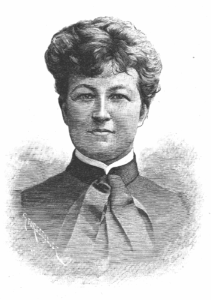
Xylograph of Martina Bergman-Österberg published in Idun in 1890.
Martina Bergman-Österberg was born in 1849 in Hammarlunda, rural Sweden. Educated at home, she was first employed as a governess and later, a librarian. In 1879, Österburg commenced a two-year course at the Royal Central Institute of Gymnastics (RCIG) in Stockholm, studying pedagogical (physical education) and medical (physiotherapy) gymnastics from the work of Pehr Henrik Ling.
In 1881 Österberg was appointed to the London School Board as Lady Superintendent of Physical Exercises in Girls’ and Infants’ schools. She was the successor of another Swede, Concordia Löfving, a fellow graduate of the RCIG. The appointment of Swedish nationals in the role occurred because at the time no English-born teacher possessed sufficient qualifications to teach physical education.
Österberg was responsible for the instruction of female physical training teachers and with certifying their competence. During her appointment she trained over 1,300 teachers in Swedish gymnastics, anatomy and physiology, and pioneered a national system of physical training instruction. Most of her work focused on training educators for elementary school students, and during her time at the London School Board she introduced Swedish gymnastics to nearly 300 schools. By 1888 Swedish gymnastics was being taught by qualified teachers in girls’ schools in every department of the London School Board.
Dissatisfied with the bureaucracy at the London School Board, and feeling stifled in achieving her aims, Österburg shifted towards teaching middle-class women to become physical training instructors. She developed a two-year course modelled on the RCIG that included anatomy, physiology, chemistry, physics, hygiene, massage, theory of movement, dancing, deportment and remedial (medical) gymnastics. Although not well understood by the Swedes, English team sports were also taught at The Österburg Physical Training College for their potential to teach an appreciation of space and time, discipline, reason, quickness and unselfishness (Oesterberg, 1911).
In 1893, Österberg returned from a visit to the United States, and informally introduced a version of basketball to her students. Two years later, an American lecturer by the name of Dr Toles more formally introduced women’s basketball to Österberg’s students, however in the absence of suitable equipment wastepaper baskets were used for goals (Claydon 2021b). Substantial revisions were made during a visit in 1897 from another American teacher and graduate of the RCIG, Miss Porter of Baltimore. By this time, the sport had also acquired a new name of ‘net ball’ to reflect the transition from baskets to rings and nets. The game was also now played on outdoor grass courts divided into three parts and a larger ball was used.
The Ling Association
In 1899 a group of Österberg’s graduate students formed The Ling Physical Education Association. Their objects were threefold:
- to place physical education on a higher basis than before;
- to obtain a registered list of those duly qualified to teach Swedish Gymnastics and to give Massage in a thoroughly trained manner; and
- to arrange meetings and courses.
Just as women graduates of the RCIG could work in either pedagogical (physical education) or medical (physiotherapy) gymnastics, so too did members of the Ling Association. However, over the next 15 years the two disciplines cleaved into separate professions with the Ling Association morphing into the Physical Education Association of the United Kingdom. Meanwhile those graduates predisposed to medical (physiotherapy) gymnastics joined with the ‘nurse-masseuse originated’ Society of Trained Masseuses (STM). Acknowledging their gymnastic partners, the masseuses of the STM eventually changed their name in 1920 to the Chartered Society of Massage and Medical Gymnastics, and in 1943 to the Chartered Society of Physiotherapy (Nias, 2017).
Back to the history of netball: As many of the students of the Österberg College finished their training and became gymnastic mistresses in distant schools who wished to play against each other, the need for uniform netball rules became apparent. Several of the 1898 class graduates decided that the time had come to standardise the rules. It seemed fitting to them that their new Association should take responsibility, so a subcommittee to codify the rules of netball was formed in 1900 (Claydon, 2021a). Their vision to develop a standard set of rules for netball, which could be used by all schools and groups wishing to play, was far reaching.
In 1901 The Ling Association published 250 copies of the rule book. Next came a print run of 1000, increasing until they reached 2,500, with many sent to schools in England, Scotland, Ireland and Wales and to a few schools in France and South Africa (Claydon, 2021b).
Netball’s Growth
Netball’s popularity continued to grow In the first half of the 20th century, with the game being played in many British Commonwealth countries. During a tour of England in 1957 by an Australian national team, discussions took place concerning standardising the rules of the sport internationally and this led to representatives from England, Australia, New Zealand, South Africa and The West Indies meeting in Sri Lanka in 1960, to establish The International Federation of Women’s Basketball and Netball. Formal rules were established at this inaugural meeting and it was decided to hold World Championship tournaments every four years, beginning in Eastbourne, England, in 1963.
Netball has since become the most popular and widely played sport by women in Australia and New Zealand (Hess, 2022). Its cultural value, professional opportunities, and strong feminine identity have lodged it firmly as an integral component of women’s athletics around the world.
References
Claydon J. (2021a). The Ling Association Founded 1899. The Österberg Collection. Accessed online at https://osterbergcollection.org.uk/wordpress/wp-content/uploads/2021/07/The-Ling-Association-rev.17.6.2021-web.pdf.
Claydon J. (2021b). Madame Bergman Ӧsterberg, her students and the Ling Association: Their influence on the development of Netball 1895–1930. The Österberg Collection. Accessed online at https://osterbergcollection.org.uk/wordpress/wp-content/uploads/2021/03/Netball-1895-1930-web.pdf
Hess R. (2022). Origin Stories: Tracing the Development of Netball in Victoria during the Late Nineteenth and Early Twentieth Century. The International Journal of the History of Sport, 39(13–14), 1436–1461.
Nias K. (2017). Negotiating intimacies: Gender, rehabilitation and professionalisation of massage in Britain, c.1880-1920. PhD thesis submitted to Exeter University. Accessed online at https://www.proquest.com/openview/63678b7244d4bbf945099a3fb34259e3/1?pq-origsite=gscholar&cbl=51922&diss=y.
Oesterberg M. (1911). Gymnastics and games for girls. In The Teachers Encyclopedia. The Österberg Collection. Accessed online at https://osterbergcollection.org.uk/wordpress/wp-content/uploads/2023/08/DATBO_2009_71-Gymnastics-and-games-for-girls-web1.pdf
