

In his new book, Fisioterapia 1903–2024: Lento reconocimiento como ciencia propia (y hay quien lo niega, todavía) (Physiotherapy 1903–2024: Slow Recognition as a Distinct Science [and There Are Still Those Who Deny It]), physiotherapist Lendoiro-Salvador traces the more than century-long struggle for Spanish physiotherapy to be recognised as a distinct scientific discipline, with its own university schools, qualifications, professionals, research and publications. (Published in Spanish.)
Since classical antiquity, health sciences were encompassed under the denomination of Medicine and practiced by medical professionals. Other disciplines were progressively recognised as distinct (Pharmacy from the 12th and 13th centuries, Nursing, etc.), with specialised studies in each science being created in universities (teaching, titles, professional practice and research).
The slow recognition of physiotherapy was particularly striking given the significant scientific advances made in the late 19th century across its various fields, including hydrotherapy, kinesiotherapy, electrotherapy, manual therapy, mechanotherapy, and workplace physiotherapy.
Why was there a delay in its recognition as a distinct profession and science, despite the creation of the first physiotherapy societies in the Netherlands (1889) and Great Britain (1894)?
From the late 19th and early 20th centuries, Spanish universities began offering training in certain aspects of physiotherapy, but in a very deficient manner, and only to physicians.
Faced with this inadequate training, the physicians with the greatest interest in this science had to undertake the study and research of physiotherapy on their own initiative. In Spain, doctors who specialized in physiotherapy were known as “practical doctors”, and some sought to integrate the discipline into other sections of medicine, one of the reasons for its slow recognition.
The first “Physiotherapy Society” in Spain was established on the night of April 30, 1903, by physicians who had conducted research and clinical practice in electrotherapy, manual therapies, kinesiotherapy, mechanotherapy, and hydrotherapy.
The driving force behind this Physiotherapy Society was Jaime Mitjavila, a military physician who founded his own School of Physiotherapy (1907). However, as he also practiced in the fields of radiological medicine (or physical medicine), he sought to include physiotherapy with radiology. Unfortunately, both the Society and the School ceased to exist upon Mitjavila’s death (1910).
It was common for medical graduates to focus on only one aspect of the science of physiotherapy. For instance, in Spain, the neuropathologist Teodoro Gaztelu praised the physiological and therapeutic effects of electrotherapy (1910). Conversely, Joaquín Decref—who focused exclusively on mechanotherapy—attempted in 1913 to ridicule research and clinical practice in electrotherapy.
These physiotherapists or “practical doctors”, did not conceal their clinical practice and research in physiotherapy. For instance, in the second edition (1914) of a book on manual therapies by Juan Vendrell, the author was identified as the “first massage physician” at several hospitals in Barcelona.
There were also attempts to prevent the recognition of physiotherapy as a distinct science by including it under various branches of medicine (such as neurology, radiology, orthopedic surgery, or traumatology) or even under other disciplines like gymnastics and physical education.
The scientific development of its various sections, prompted the holding of the first International Physiotherapy Congresses starting in 1905.
This conflict also arose at the First Congress of Physiotherapy (Liège, August 12–15, 1905). Practitioners of physiotherapy were divided into two opposing camps: some advocated for its integration with radiological medicine, while others sought its union with surgical-orthopedic medicine. At the Second International Congress of Physiotherapy (Rome, August 13–16, 1907), the uniting of physiotherapy with radiological medicine was continued.
Physiotherapy congresses were also held in various countries. France is particularly notable in this regard, hosting national physiotherapy congresses in Paris (the first in April 1908 and the second in April 1909).
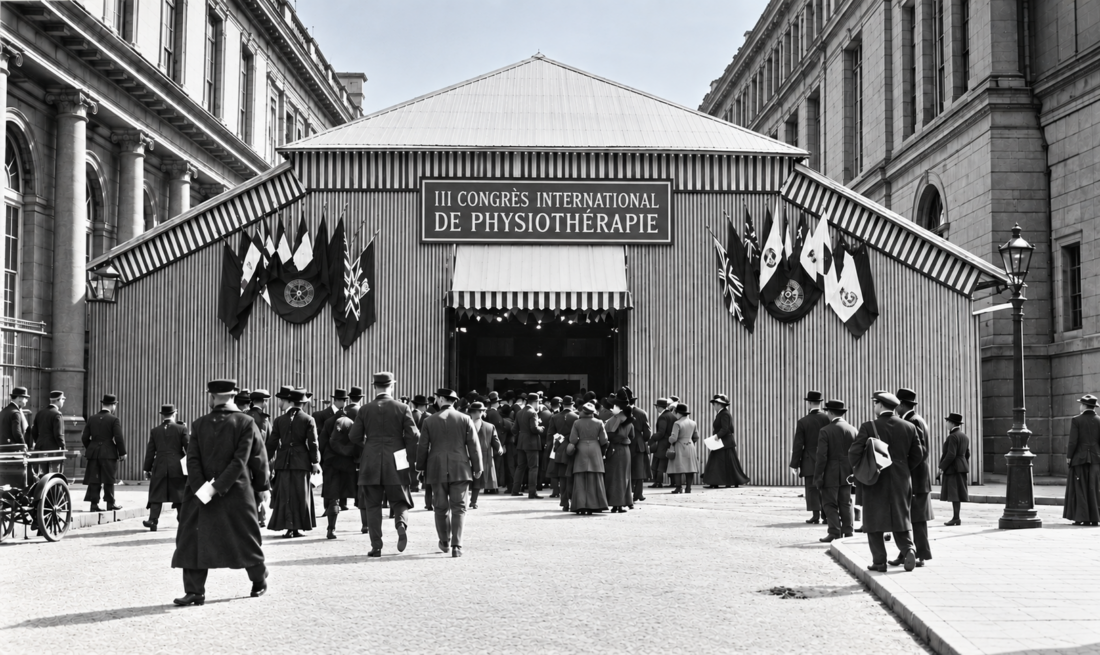
The “III International Congress of Physiotherapy” was held in Paris, 29 March – 2 April, 1910. It was organized by the French government, with the collaboration of the Academy of Medicine and the societies for therapeutics, electrotherapy, kinesitherapy, hydrology, and climatology, among other French societies. It featured three official topics and seven sections. It was presided over by M. Landoury, Dean of the Faculty of Medicine.
Congresses of this type were also held in Germany. For example, the 4th International Congress of Physiotherapy took place there from March 25 to 30, 1913.
A prime example of attempts by other disciplines to absorb physiotherapy—thereby preventing it from being recognized as a distinct science—was the Congress on Physical Education and Physiotherapy celebrated in Paris, 17-20 March 1913.
These congresses came to an end with the outbreak of World War I. Following the war, new opportunities arose to recognise physiotherapy as a distinct science; scientific and professional advancements in the field of physiotherapy made it impossible for “practical doctors” to continue providing clinical physiotherapy services while simultaneously practicing other areas of medicine. Nevertheless, its full recognition continued to be delayed.
From that time on, an impossible duality regarding physiotherapy emerged. On one hand, it was expected that physicians would theorise about teaching and research in the field, despite lacking clinical experience; on the other, actual clinical physiotherapy practice was to be carried out by specialised personnel or physiotherapists who were barred from teaching, conducting research, or publishing. Books on physiotherapy were even produced to train the specialised staff—books that contained no bibliographic references whatsoever, neither within the text nor at the end.
The medical profession managed to keep delaying the recognition of physiotherapy as a distinct science, with its own university schools, qualified professionals, publications, and research. Consequently, other physiotherapy schools in Spain also failed (in 1930 and 1935). They succeeded in delaying this recognition until the second half of the 20th century—and, in some respects, until the beginning of the 21st. Even today, there are still those who deny it.
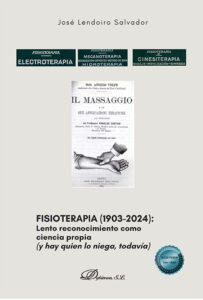
Fisioterapie 1903-2024 Book Cover
Fisoterapie (1903-2024): Lento reconocimiento como ciencia propia (y hay quien lo niega, todavía)
Editorial: Dykinson
Edición: 1ª ed
Año: 2026
Idioma: Español / lengua española
ISBN: 979-13-7047-404-1
ISBN electrónico: 979-13-7047-470-6
Depósito legal: M-16604-2026
Ver DOI: https://doi.org/10.14679/5042
