

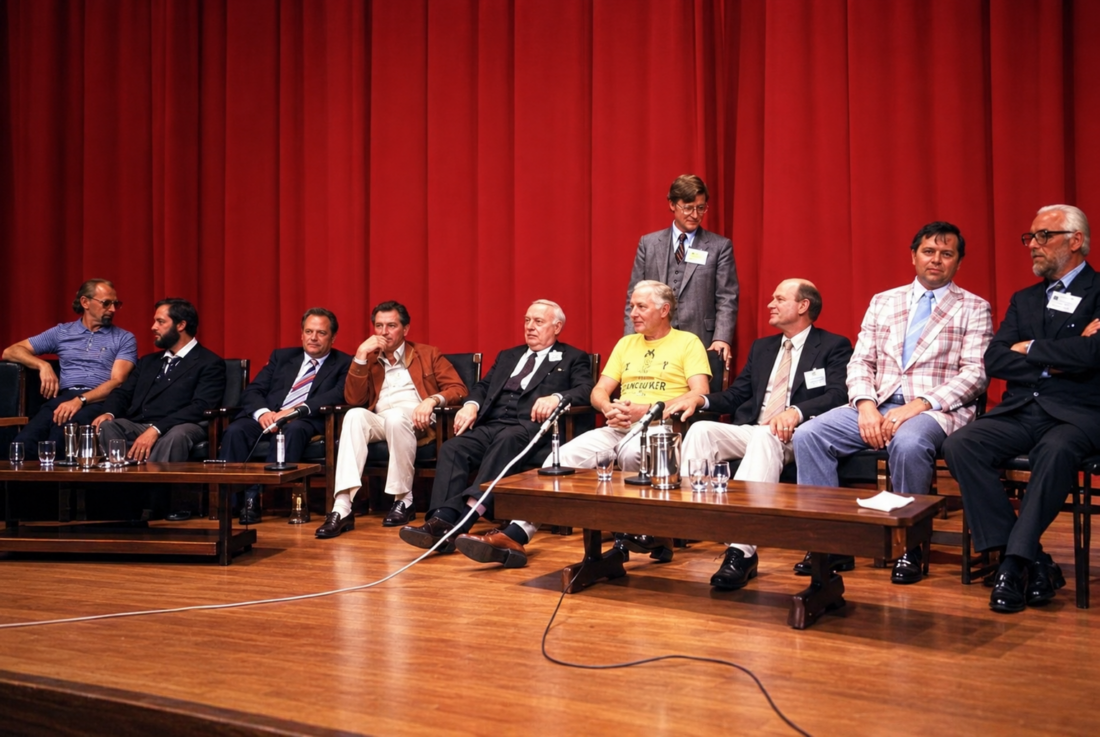
You may have heard the term “derangement” and immediately thought of Robin McKenzie’s Derangement Syndrome. But the story of the term goes back further. McKenzie was strongly influenced by the work of British orthopaedic surgeon Dr James Cyriax, and his approach can be seen, in part, as a transformation of Cyriax’s ideas about internal joint derangement.
Understanding this history provides an interesting insight into how thinking about mechanical musculoskeletal disorders changed during the twentieth century—from a model centred on identifying and mechanically correcting a structural lesion, to one that placed much greater emphasis on movement, mechanical behaviour and patient self-management.
Cyriax and the idea of internal derangement
The concept of internal joint derangement was central to the Orthopaedic Medicine developed and popularised by James Cyriax (1904–1985). For Cyriax, a derangement involved the displacement of relatively inert tissue within a joint, producing a mechanical obstruction to normal movement.
The displaced material might be a meniscal fragment, a loose body of cartilage or, in the spine, intervertebral disc material. The important feature was that the displaced tissue altered the normal mechanics of the joint.
A mechanical obstruction
Cyriax’s model had three main elements:
- Displacement of inert tissue. A fragment of intra-articular tissue—such as a meniscus, loose body or disc material—was displaced from its normal position.
- Mechanical obstruction. The displaced tissue interfered with the normal slide and glide of the joint surfaces.
- A directional restriction. Because the obstruction was localised, movement could be restricted in one direction while other movements remained relatively normal.
This was quite different from the pattern of restriction associated with arthritis, where movement is generally limited in a more predictable, proportional fashion.
Recognising a derangement clinically
Cyriax developed his system of Selective Tissue Tension Testing to help identify the affected tissues. One of the important clinical clues was what he called a non-capsular pattern—an asymmetrical or apparently arbitrary restriction rather than the predictable pattern associated with joint disease. A knee that could flex normally but could not fully extend, for example, might suggest an internal derangement.
Another characteristic finding was the springy block end-feel. Passive movement towards the restricted position produced an elastic or spring-like resistance, as though the joint were encountering a physical obstruction. Patients might also describe a sudden onset, sharp “twinge”, catching, locking or giving way.
Derangement in the spine
Cyriax applied the concept of internal derangement to both peripheral joints and the spine. In peripheral joints such as the knee or hip, the offending material might be a loose body, meniscal fragment or osteochondral fragment. In the spine, Cyriax regarded displaced intervertebral disc material as the likely source of the mechanical problem.
He described two principal types of spinal disc displacement:
- Annular protrusion involved displacement of the outer fibrocartilaginous annulus. Cyriax advocated rotational manipulation as a means of mechanically reducing the displaced material.
- Nuclear protrusion involved outward migration of the gelatinous nucleus pulposus. In this situation, Cyriax believed manipulation was ineffective and advocated sustained mechanical traction to reduce intradiscal pressure and encourage the nuclear material back towards the centre.
These ideas became an important part of Cyriax’s approach to spinal disorders.
From Cyriax to McKenzie
The influence of Cyriax on Robin McKenzie is difficult to overlook. McKenzie studied Cyriax’s work during the 1950s and initially incorporated many of his ideas into his own clinical practice.
But McKenzie eventually took the concept of derangement in a very different direction. Both clinicians regarded mechanical derangement as important, but they differed considerably in how they understood it, how they diagnosed it and, most importantly, how they treated it. The difference can be summed up as a shift from “What structure is displaced?” to “How does the disorder behave when we move it?”
From structural pathology to mechanical behaviour
Cyriax was intensely interested in the anatomical lesion. He spent considerable effort trying to distinguish different types of disc pathology because, in his model, the nature of the tissue determined the appropriate treatment. McKenzie gradually moved away from the need to identify the precise anatomical lesion.
His observation was remarkably pragmatic: if a particular movement repeatedly reduced pain and restored movement, perhaps it was not necessary to know exactly which piece of tissue was responsible. Rather than beginning with a presumed anatomical diagnosis and then selecting a treatment, McKenzie increasingly began with the patient’s mechanical response and used that response to guide treatment. This was a significant change in clinical thinking.
The discovery of centralisation
Cyriax recognised that disc lesions could produce referred pain and radicular symptoms, but his assessment model was essentially static. McKenzie’s observations led him towards something different.
In 1956, an unexpected incident involving a patient known as Mr Smith became the famous turning point in the development of his approach. McKenzie discovered that sustained lumbar extension, which he had previously regarded with considerable caution, could produce a dramatic change in his patient’s symptoms.
Mr Smith’s leg pain disappeared and his remaining pain moved towards the centre of his lower back. This became the phenomenon McKenzie later called centralisation. The movement of pain from a more distal location towards the spine became an important clinical sign. Rather than simply recording whether a movement was painful, McKenzie began observing what happened to the symptoms after repeated movements.
This was a major conceptual shift: the patient’s response to movement became a diagnostic and prognostic tool in its own right.
From passive treatment to patient autonomy
The difference between Cyriax and McKenzie was not simply one of technique. It reflected a broader change in the role of the patient. Cyriax’s model placed considerable emphasis on the skill of the clinician. If a derangement was mechanically displaced, the clinician needed to identify it and use manipulation, traction or other techniques to reduce it. McKenzie asked whether the patient’s own movements could achieve a similar result.
This led to a fundamental principle of the McKenzie approach: the patient should, wherever possible, become responsible for managing their own condition. Repeated movements and sustained positions could be prescribed according to the patient’s directional preference. The clinician’s role was increasingly to identify the appropriate mechanical strategy, teach the patient how to use it and intervene manually when self-treatment was insufficient.
The evolution of McKenzie’s approach
The development of McKenzie’s Mechanical Diagnosis and Therapy (MDT) can therefore be viewed as an evolution of ideas that were already present in twentieth-century Orthopaedic Medicine.
1952–1953: The beginning
Robin McKenzie graduated from the New Zealand School of Physiotherapy in 1952 and opened his private practice in Wellington in 1953. At the time, Cyriax’s concepts of soft-tissue lesions and internal disc derangement represented an important part of advanced orthopaedic thinking. McKenzie studied and applied these ideas, including passive testing, deep transverse friction and manual traction.
1956: The Mr Smith incident
A patient, Mr Smith, presented with severe acute low back pain and sciatica extending towards his knee. He had already received several weeks of treatment without improvement. Through an accident involving the positioning of the treatment table, Mr Smith spent several minutes lying prone in sustained lumbar extension.
McKenzie returned expecting the worst. Instead, his patient reported that his leg pain had disappeared. The remaining pain was now concentrated in the centre of his lower back. This unexpected result challenged much of what McKenzie had previously believed about lumbar extension. Rather than dismissing the incident, he investigated it.
1957–1966: Experimenting with movement
Over the following decade, McKenzie systematically explored the effect of repeated movements on patients with spinal pain. Instead of relying primarily on passive treatment, he began asking what happened when patients repeatedly moved their own spines towards the end of their available range.
From these observations emerged the concepts of centralisation and directional preference. McKenzie increasingly concluded that the mechanical behaviour of a patient’s symptoms could be more clinically useful than trying to determine the precise anatomical structure responsible for them.
The 1970s: A new mechanical model
During the 1970s, McKenzie formalised his classification system, describing three mechanical syndromes:
- Derangement
- Dysfunction
- Postural syndrome
At a time when passive treatment, physical modalities and prolonged bed rest remained common, McKenzie’s emphasis on movement and active patient participation represented a significant departure from conventional practice. His ideas spread internationally, challenging established approaches to the management of spinal pain.
1980–1982: Putting the patient in charge
In 1980, McKenzie published Treat Your Own Back, deliberately placing self-management at the centre of his approach. In 1981, he published The Lumbar Spine: Mechanical Diagnosis and Therapy, setting out his developing clinical model in greater detail.
The following year, the McKenzie Institute International was established, helping to formalise and disseminate MDT education internationally.
A change in the way physiotherapists thought
The history of “derangement” is therefore more than a story about two clinicians. Cyriax and McKenzie shared an important starting point: musculoskeletal symptoms could have a mechanical basis, and mechanical intervention could change those symptoms. But they approached the problem differently.
Cyriax concentrated on identifying the structure and lesion. McKenzie increasingly concentrated on observing mechanical behaviour and symptomatic response. That change—from structural diagnosis towards mechanical behaviour, and from clinician-directed treatment towards patient autonomy—was one of the significant developments in twentieth-century musculoskeletal physiotherapy.
The concept of derangement provided part of the starting point. The observation of what happened when patients moved provided the next step. And from that combination emerged one of the most influential mechanical approaches to the assessment and treatment of spinal disorders in modern physiotherapy.
NB: This article was written and edited with the assistance of AI. The image was enhanced with AI. The full article, with references, is available online at https://retlouping331888347.wordpress.com/2026/10/05/the-history-of-derangement-from-cyriax-to-mckenzie/
