

Among contemporary physiotherapists, the Swedish poet, gymnast, and fencing master Pehr Henrik Ling (1776–1839) remains a relatively obscure historical figure. However, if anyone should be honoured with the epithet “the father” of the physiotherapy profession it is Ling.
In 1813 Ling founded the Royal Central Institute of Gymnastics (RCIG) in Stockholm, the school from where the first physiotherapists were minted. At the RCIG Ling introduced and developed his advanced gymnastic system that, besides military gymnastics and pedagogical gymnastics (physical education), included physiotherapy – then labeled as medical or Swedish gymnastics. Ling’s physiotherapy quickly gained acceptance as effective for many ailments and chronic diseases. Due to this recognition, the Swedish Society of Medicine elected him a member in 1831 (Ottoson, 2005). Over the next 100 years, physiotherapy spread globally and Ling became an international renowned medical figure, hailed by his many followers as the genius that had made physiotherapy scientific.
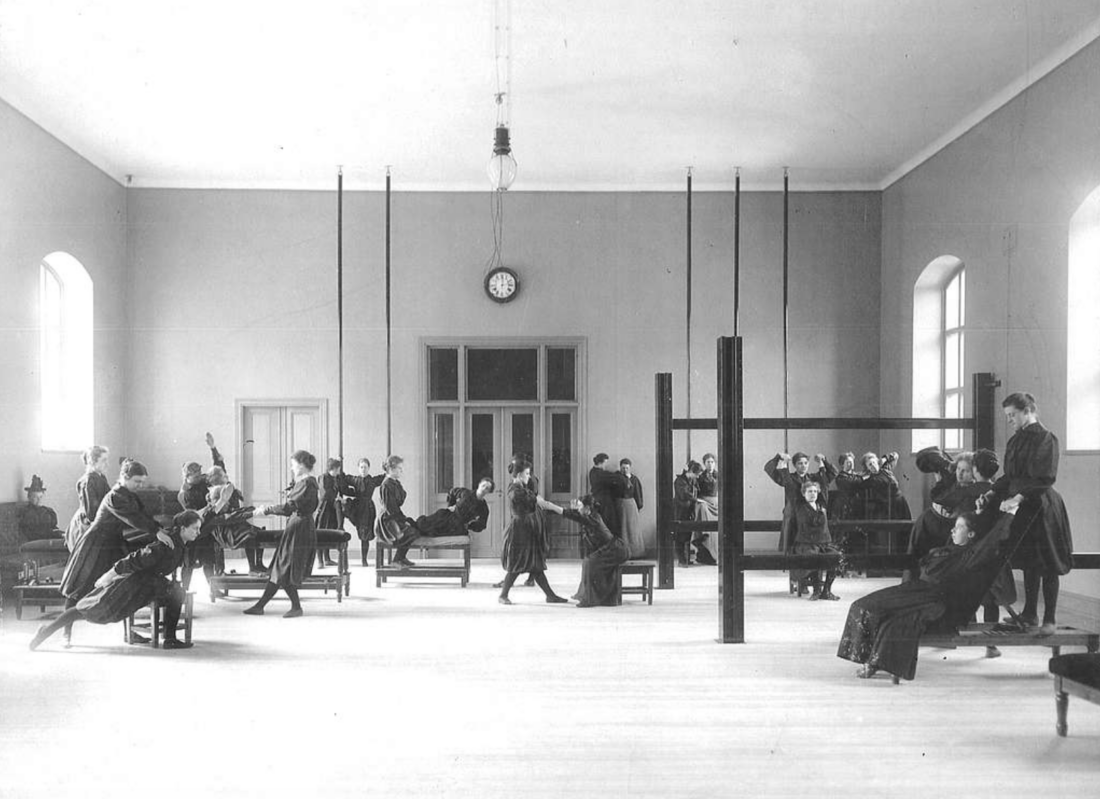
At the end of the 19th century an increasing number of women began practicing physiotherapy and therefore most of the physiotherapy schools that started around 1900 targeted female students. Regularly these had the RCIG’s physiotherapy training as a blueprint. Aside Ling’s system’s great international presence and reputation there were two major interdependent reasons for this. One was that the RCIG, since 1864, had a two-year program for female physiotherapists (three years for men) with unparalleled high standards for student admittance. All students also received classes in anatomy, physiology and pathology. The other was that the RCIG’s students became licensed as physiotherapists by the Swedish government. Of course, this was something to strive for in a time were women seldom had such educational and professional opportunities (Nias, 2017; Ottoson, 2026).
Early Years
But who was Ling, the man who laid the foundations for the physiotherapy profession, as we know it today? Lauded by his admirers, including many physicians, there are plenty of “inflated” stories about his life and persona. That said, Ling was the son of a priest and after he had taken his maturity exam at the University of Lund, he appears to have spent some years in Stockholm working as clerk and private tutor. At the same time, he began writing and translating dramas. According to his personal resume he also studied theology at the University of Uppsala, north of Stockholm (Lindroth, 2004).
At the turn of the century, and for unclear reasons, Ling moved to Copenhagen where he studied literature and languages. In the Danish capital he got the impulses that would form his career as poet – national romanticism – which ultimately rendered him a chair in the Swedish Academy. His literary production was marinated in Norse mythology – Ling was called “the Bard of Aesir” – where powerful Vikings were a favourite motive. They were praised for their fearlessness and strong physique. It was also in Copenhagen Ling became interested in physical upbringing. He was smitten by popular continental trends in physical education and pedagogy. He trained regularly at the Dane Franz Nachtegall’s private gymnastic institute, who, among others, was inspired by the German pedagogue J. C. F. Guts Muths and especially his work Gymnastik für die Jugend (1793, Gymnastics for Youth). To contemporary pedagogues with a passion for physical education fencing was often closely aligned with gymnastics, and Ling soon became a skilled fencer. In this regard Ling’s hagiographers often ascribe him with unprecedented capabilities. The stories tell that he, close passing away, would rise from his deathbed, bare-chested, and with sharp weapons humiliate Swedens’s best fencers. Of more direct interest to physiotherapists is that Ling credited fencing for him becoming aware of the healing capacities of physiotherapy. He stated that,
the arm that by the surgeon’s hand is immobilised in bandages becomes milky and powerless but taking lessons by a fencing master makes it strong again” (Moberg, 1920).
During his stay in Denmark Ling’s chroniclers often mention that he made trips to the continent where he served in the Prussian as well as the French national forces. To what extent these adventures took place is rather uncertain though (Ljunggren, 1999). Regarding Ling’s 19th century status as “inventor of scientific physiotherapy”, another legend about Ling’s travels in Europe is more interesting. In is often said and still passed on in modern international articles about him, that he once met a Chinese national that taught him Cong Fu (Kung Fu), and that this experience was the main source behind the movements Ling included in his physiotherapy system. However, there is nothing concrete that can substantiate this elaborate “Chinese connection”. More likely the source behind this close encounter is a story “invented” in the 1850s by the French educationalist Nicholas Dally, who, like many others, wanted to make a name for himself as scientific pioneer in physiotherapy. To be able to compete with Ling’s already strong symbolic standing in that domain Dally tried to make Ling look like a plagiarist with no real originality. He began proclaiming that Ling had studied the famous work of the French Jesuit and China missionary Jean Joseph Marie Amiot (1718-1794), that had translated to French many Chinese texts, including one about “Coung Fou des Tao-See”. When Dally’s accusations evolved into a personal meeting between Ling and a travelling man from China, is still unclear. It is also doubtful that Dally’s allegation had any severe impact on Ling’s scientific inventor status in the 19th century, but the legend survived, nonetheless. In the eleventh edition of Encyclopedia of Brittanica (1910-11), the worlds most circulated encyclopedia, one can read under the entry “Massage”, that the “Swedish gymnastic system instituted by Pehr Henrik Ling is derived from the book of Cong-Fou, the bonze of Tao-Sse” (Ottoson, 2026).
Gymnastic Beginnings
In 1804 Ling left Copenhagen for Sweden. He moved to Lund where he assumed the position as the university’s fencing master. The academic milieu allowed Ling to befriend many of Sweden’s then leading intellectuals. His interest in gymnastics was now probably deepened even more via the pedagogue Otto Lindfors, later professor in history, who was inspired by classical Greek gymnastics and that wrote theses about physical upbringing. Besides his ordinary duties in the palestra Ling also studied anatomy under Professor Arvid Henrik Florman. Ling’s studies under Florman’s guidance were likely important to his strong conviction that “true” gymnastics had to be based on scientific principles. In the main work on his system, Gymnastikens allmänna grunder (1834). The main principles of Gymnastics, Ling (1834) declared that “anatomy…was the dearest source of knowledge for the Gymnasts” and that must be paired with “the inseparable spouse of Anatomy: Physiology”.
In 1813 Ling moved to Stockholm. Prior to this he had started to lobby for improved physical education of the youth on a national basis. The main political driver behind this strong conviction was the devastating war with Russia in 1809, where Sweden had to surrender its eastern half – Finland – to the Czar. Ling, and many others, blamed the bad fortunes in the battlefield on a weakened population, hence a need for physical restoration. Through gymnastic training Sweden’s youth and Army would become strong again and ideally able to take Finland back. The topic was addressed in the governmental “Upbringing committee of 1812” where several of Ling’s friends participated. The committee was positive, and Ling was ordered to plan for the founding of the RCIG. Ling would become the school’s first Head and professor (Ljunggren, 1999). At the same time, he was also assigned to become the Royal War Academy’s fencing master. According to RCIG first statutes of 1814 the Head had to,
master a complete knowledge of Gymnastics based on the principles of Mechanics, Osteology [science of bones] and Myology [science of muscles] and the skills regarding its adjoint exercises, where fencing with Sabre and Rapier, voltige on living horses and swimming are included.” (“Kungl. Gymnastiska Centralinstitutets historia 1813-1913”, 1913).
The idea was that after graduation the students should spread around the country implementing Ling’s physical education in school gymnasiums and regiments. The first students were civilians but soon the school was ‘flocked to’ by military personnel. Around 1830 the bulk of students were commanded Army officers, and as indicated, this would not start to change until 1864 when women were allowed to qualify for the RCIG’s classes (military gymnastics excluded). Around 1900 the student corpus’ gender ratio was even but the acceptance rate was much lower for the women. Their program had evolved into one of the most popular and prestigious ones in Sweden. Many applicants were turned down, which ultimately paved the political way for new physiotherapy schools in Sweden, that could better satisfy the female demand.
Physiotherapy
With the RCIG’s martial and strength training background in mind, it is perhaps confusing why Ling became “the father” of the physiotherapy profession” and that RCIG’s students also became physiotherapists; experts in dealing with sick bodies? The short answer is that Ling was convinced that a science-based gymnastic system had to include both the healthy and the sick body. And in that regard, he viewed physiotherapy had the scientific pillar of his gymnastic system. Metaphorically Ling said physiotherapy was the root that organises “the laws of all human movement; because without this root pedagogical gymnastics loses its corrective nature, and it will have little value, and no unity.” In fact, for several decades the RCIG was dominated by physiotherapy activities. The high scientific status and believed potency of Ling’s physiotherapy was of course contributing to this emphasis. Around 1840-50 the RCIG probably had Sweden’s most elite polyclinic and professors from the Karolinska Institute, today awarding the Nobel Prize in medicine or physiology, sent patients there (Hansson & Ottoson, 2015; Ottosson, 2026).
Many RCIG-alumni also left the Army and Sweden to take on civil careers, opening private physiotherapy clinics abroad, and later the RCIG female alumni did the same. Among these Signe Brunnstrom is probably the most famous name today, not least thanks to her seminal work Clinical Kinesiology (1962) and the “Brunnstrom approach” that have formed generations of physiotherapists (Schleikorn, 1990). Another explanation for why physiotherapy became so prominent is more materialistic, but nonetheless important. The prospects of earning decent money were much greater as a physiotherapist than that of a physical educator. The former could earn a good living on patient fees while the latter’s salary often was poor in comparison. More so this applied to RCIG’s female students, as exemplified by Signe Brunnstrom. Opening a private clinic abroad became the number one incentive for the women sending in applications to the RCIG (Ottoson, 2016).
References
Hansson N & Ottoson A. (2015) “A Nobel Prize in Physical Therapy? The Rise and Fall of Medico-Mechancial Institutes”, Physical Therapy, 96, 1184-1194.
“Kungl. Gymnastiska Centralinstitutets historia 1813-1913”. (1913). Stockholm, p. 25. Translation by the author.
Lindroth J. (2004). Ling – från storhet till upplösning. Studier i svensk gymnastikhistoria, Symposion.
Ling PH. (1834). Gymnastikens allmänna grunder, Stockholm, 1834/1840, p. 138. Translation by the author.
Ljunggren J. (1999). Kroppens bildning. Linggymnastikens manlighetsprojekt, 1790-1914, Symposion,
Moberg G. (1920). Svenska gymnastikens märkesmän, Stockholm, p. 7. Translation by the author.
Nias K. (2017). Negotiating Intimacies: Gender, Rehabilitation and the Professionalisation of Massage in Britan, c. 1880-1920, Doctoral thesis, University of Exeter.
Ottosson A. (2005). Sjukgymnasten – vart tog han vägen? En undersökning av sjukgymnastyrkets maskulinisering och avmaskulinisering, 1813-1934, Göteborg.
Ottosson A. (2016). One History or Many Herstories? Gender Politics and the History of Physiotherapy’s Origins in the Nineteenth and Early Twentieth-Century. Journal of Women’s History, 25.
Ottosson A. (2026). The Lost Origins of Osteopathy and Chiropractic in European Mechanical Medicine and Physical Education, c. 1800-1950, Routledge.
Schleikorn J. (1990). Signe Brunnstrom. Physical therapy Pioneer, Master Clinician and Humanitarian: New Jersey.
