

This article is the second of eight invited editorials exploring the legacy of Pehr Henrik Ling on the 250th anniversary of his birth.
Pehr Henrik Ling (1776–1839), widely recognised as the founder of Swedish gymnastics, had a considerably broader influence on the development of physiotherapy than is generally acknowledged. His work shaped medical gymnastics, physical education and rehabilitation, influencing practitioners across Europe, the Americas and beyond. Yet, as physiotherapy evolved into a modern healthcare profession, Ling’s name and contribution gradually disappeared from its literature.
To understand this legacy, it is useful to consider the parallel development of therapeutic massage, particularly the work of English physician John Grosvenor (1742–1823). Although contemporaries, the two men approached treatment differently. Grosvenor, a medically trained physician, practised massage in England, while Ling, largely self-taught, concentrated on the therapeutic effects of movement in Sweden. Their traditions initially developed independently, subsequently overlapped and eventually followed different paths.
Two Traditions: Massage and Medical Gymnastics
Ling’s system incorporated three categories of movement: active, passive and combined. Passive movements included techniques recognisable as massage, although massage was a relatively minor component of his approach. His principal interest was the analysis and therapeutic application of movement.
The massage tradition associated with Grosvenor developed further through the work of Dutch physician Dr Metzger, who became internationally recognised for massage and manipulation.
By the late nineteenth century, massage was firmly established in medical practice. Publications such as David A Graham’s (1884) A Practical Treatise on Massage concentrated on massage as a distinct discipline . Other influential works, including those by Taylor (1885) and Schreiber (1887), increasingly brought massage and medical gymnastics together. The two traditions were beginning to converge as the twentieth century approached.
Ling’s Legacy and its International Spread
A major vehicle for Ling’s influence was the Royal Central Institute of Gymnastics (RCIG), which he established in Stockholm in 1813. Its graduates developed and disseminated his methods, both within Sweden and internationally.
One particularly influential graduate was Martina Sofia Helena Bergman-Österberg (1849–1915). After completing her training in 1881, she moved to England and established the first college there dedicated to training women as physical education instructors. She pioneered physical education as a formal school subject, with Swedish gymnastics at its centre. Her curriculum included anatomy, physiology, hygiene, movement theory, dancing, gymnastics and massage.
In 1899, some of her graduates established the Ling Association to support practitioners and promote Swedish gymnastics and physical education. Bergman-Österberg disapproved and established a rival organisation, the Ling Österberg Union. The two organisations merged after her death in 1915. The Ling Association subsequently evolved into an organisation principally concerned with physical education.
However some practitioners retained an interest in Ling’s medical gymnastics and joined the Society of Trained Masseuses, which became the Chartered Society of Massage and Medical Gymnastics (CSMMG) around 1920. These practitioners would eventually become known as physiotherapists and the Society, the Chartered Society of Physiotherapy. Thus, Ling’s influence continued through two distinct pathways: physical education and the developing profession of physiotherapy.
Ling’s particular contribution was his systematic analysis of movement and its effects. John Harvey Kellogg (1929), writing in The Art of Massage, recognised Ling’s work in analysing and systematising movements. Ling also developed new movements and combinations, associating them with specific therapeutic effects and providing precise instructions for their execution.
His achievement was therefore not simply introducing gymnastics into medicine, but establishing a systematic approach to the classification and therapeutic application of movement. His interests also extended to military gymnastics, including movement for bayonet fencing. Although initially opposed by the Swedish medical establishment, his innovations eventually received royal recognition, and he was conferred the title of Professor. His final major work was completed posthumously by colleagues in 1839 (Ling, 1840). His son, Hjalmar, subsequently made a distinguished contribution to school gymnastics.
Ling’s influence spread well beyond Sweden. Early advocates included IGI de Betou, Charles Ehrenhoff and Augustus Georgii, who brought Swedish medical gymnastics to London. De Betou (1842) and Ehrenhoff (1845) established clinics and published books explaining Ling’s methods. Georgii (1850), a close associate of Ling, spent 28 years in London, mentoring practitioners trained in Sweden.
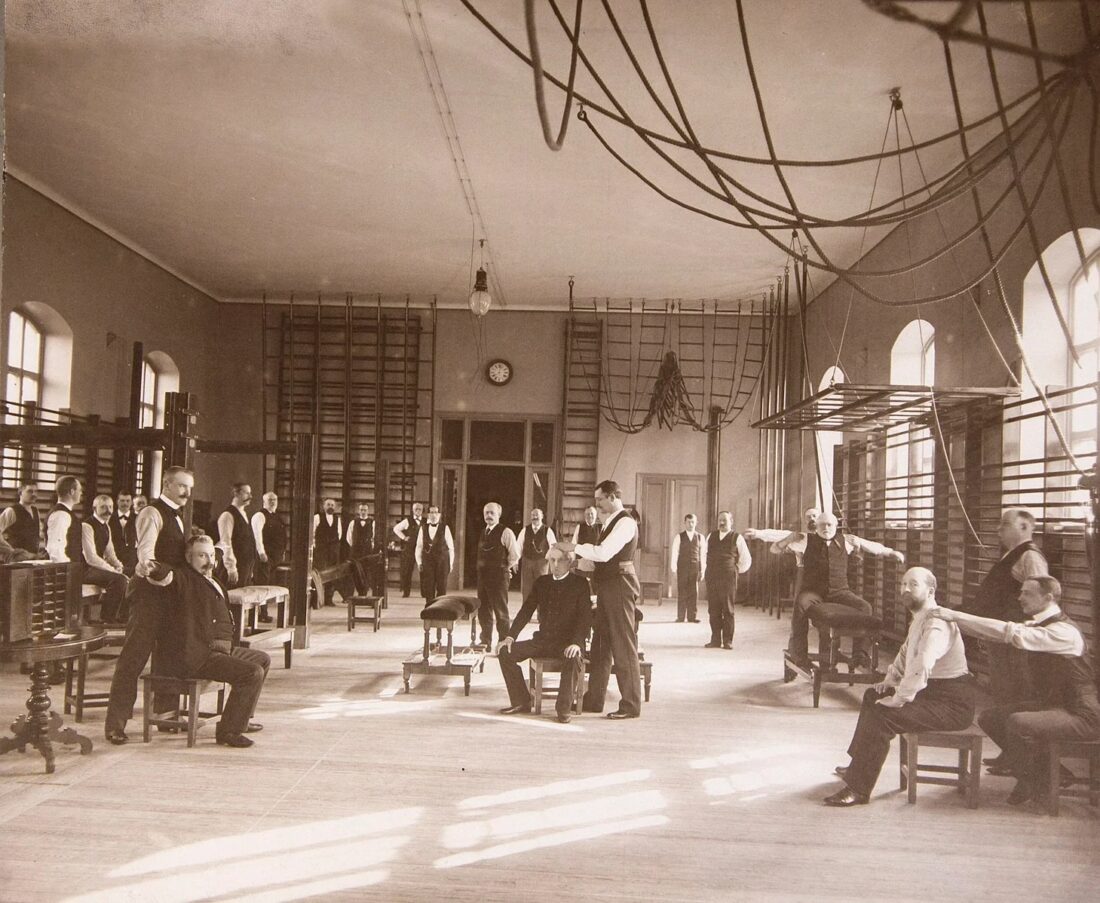
In Germany, Hugo Rothstein and Gustav Techow established the Berlin Central Institute for Gymnastics in 1847, introducing Ling’s methodology. His system also gained acceptance in Russia. Gymnastics was carried out in Saint Petersburg in a venue described as a place of magnificent scale, patronized by Russian royalty
In the United States, Baron Nils Posse (1862–1895), a graduate of the RCIG, emigrated in 1885 and rapidly established a medical gymnastics practice. With wealthy sponsorship, he secured funding for teacher-training courses and Swedish gymnastics instructors in schools. By 1890, the Ling system had been introduced into all Boston public schools and had spread to 52 American cities and towns. Posse’s manuals and publications further extended its influence (Leonard, 1927).
These developments demonstrate how a system originating in Stockholm became an international movement within a relatively short period.
Rehabilitation and the Convergence of Traditions
The First World War created enormous demand for rehabilitation, with millions of casualties requiring treatment. Massage and medical gymnastics increasingly featured together in rehabilitation centres throughout Europe, the United States and Australasia. The demands of wartime treatment also encouraged the development of new therapeutic techniques.
Subsequent advances in surgery and medical care, including blood transfusion, improved wound treatment, reconstructive surgery, skin grafting and prosthetic limbs, shortened hospital stays. Patients increasingly moved into convalescent homes, where physiotherapy provided continuing rehabilitation.
Within this changing environment, Ling’s medical gymnastics remained part of the therapeutic tradition, even as new techniques and technologies emerged.
An Overlooked Contribution: Medical Audit
Perhaps one of the most remarkable and overlooked aspects of Ling’s legacy is the early evaluation of clinical outcomes by practitioners working within his tradition.
Florence Nightingale (1863) is commonly credited with pioneering medical audit through work undertaken from 1858 and published in 1863. However, research by Goldstone (1991; 2024) identifies earlier examples among practitioners of Ling’s medical gymnastics.
de Betou (1842) published an account of 36 patients treated in London. The group comprised 25 men and 11 women, with an average treatment period of 35 days. Treatment was sometimes twice daily. He reported that 29 patients had been completely cured, all having previously experienced unsuccessful treatment elsewhere.
A larger evaluation followed when Augustus Georgii documented 692 patients treated at the RCIG during 1848–1849 (1850). Treatment generally occurred daily over two to four months. Georgii classified 267 patients as cured and 260 as relieved; the remainder either discontinued treatment or were discharged unimproved.
His results included the following:
|
Condition |
Cases |
Progress or cured (%) |
|
Cold feet |
92 |
77.2 |
|
Congestion of head |
55 |
78.2 |
|
Constipation |
51 |
80.4 |
|
Heart palpitations |
50 |
76.0 |
|
Giddiness |
36 |
64.3 |
|
Asthma |
26 |
82.6 |
|
Rheumatism |
22 |
81.8 |
|
Pulmonary consumption |
21 |
76.2 |
Georgii reported that improvement or cure was often apparent after two to three weeks. He subsequently published a further account of 399 London patients treated in 1865 (Goldstone 2024).
The diagnostic methods, treatment approaches and analytical techniques of the nineteenth century differ substantially from contemporary standards. Nevertheless, the willingness of these practitioners to document outcomes, evaluate their work and publish their findings is remarkable. Their efforts represent an early commitment to clinical evaluation, decades before medical audit became an established feature of healthcare.
The Disappearance of Ling from Physiotherapy
Despite the continued influence of his methods, Ling’s name gradually disappeared from physiotherapy literature. After 1920, new approaches and technologies changed the profession. Massage was physically demanding, and emerging physiotherapy departments increasingly adopted equipment, machinery and other therapeutic interventions. The emphasis on massage declined.
In 1943, the CSMMG became the Chartered Society of Physiotherapy (CSP). By 1950, massage had effectively disappeared from its training curriculum. Remarkably, the CSP’s 1950 massage examination paper contained no questions about massage itself.
Ling’s disappearance from the literature was equally striking. Nils Tidy’s influential publications on the emerging discipline of physiotherapy became definitive texts for generations of students, yet Ling’s name disappeared from their pages and index (Tidy, 1932). A survey of publications by five major authors — Tidy (1932), Arvedson (1931), Mennell (1934; 1945), Cyriax (1941; 1948) and Lace (1945) — covering eight books and 3,017 pages, found Ling’s name on just one page .
The contrast is remarkable. His movement principles had helped shape the traditions from which modern physiotherapy developed, yet his contribution was almost entirely absent from the literature used to educate the profession.
Reclaiming Ling’s Place in Physiotherapy History
The 250th anniversary of Pehr Henrik Ling’s birth provides an opportunity to reconsider his contribution. His influence extended well beyond Swedish gymnastics, encompassing medical movement, physical education, military training, rehabilitation and early clinical evaluation.
The traditions associated with Ling and those associated with massage eventually converged, contributing to the development of modern physiotherapy. Yet, as the profession embraced new technologies and professional identities, much of its historical connection with Ling was lost.
Swedish movement principles and therapeutic practices did not emerge in isolation. They have a history, and Pehr Henrik Ling occupies an important place within it.
References
Arvedson J. (1931). The technique, effects and uses of Swedish medical gymnastics and massage, 2nd edition. London: J & A Churchill.
Cyriax J. (1941). Massage, manipulation and local anaesthesia. London: Hamish Hamilton Medical Books.
Cyriax J. (1948). Deep massage and manipulation illustrated, 3rd edition. New York and London: Paul B Hoeber Inc.
de Betou IGI. (1842). Therapeutic manipulation or medicina mechanica. London: Simpkin Marshall.
Ehrenhoff C. (1845). Medicina gymnastica or therapeutic manipulation. London: Masters.
Georgii A. (1850). A few words on kinesipathy or Swedish medical gymnastics. London: Hippolyte Bailliere.
Goldstone LA. (1991). The Quality of Health Care and the Role of Medical Audit. Current Orthopaedics, 5(4),259-266.
Goldstone LA. (2024). Essays on massage history 1750-1950. Shrewsbury: Youcaxton Publications.
Graham DA. (1884).A practical treatise on massage: Its history, mode of application and effects. New York: William Wood and Co.
Kellogg JH. (1929). The art of massage. Battle Creek, Michigan: Modern Medicine Publishing Company.
Lace MV. (1945). Massage and medical gymnastics, 3rd edition. London: J & A Churchill Ltd.
Leonard FE. (1927). A guide to the history of physical education. Philadelphia: Lea and Febiger.
Ling PH. In Liedbeck P.J. and Georgii A (Eds). (1840). Gymnastikens allmanna grunder [On the General Principles of Gymnastics]. Upsala: Lefler and Sebell.
Mennell JB. (1934). Physical treatment by movement, manipulation and massage, 3rd edition.vLondon: J & A Churchill Ltd.
Mennel JB. (1945). Physical treatment by movement, manipulation and massage, 5th edition. London: J & A Churchill Ltd .
Nightingale F. (1863). Proposal for improved statistics of surgical operations. London: Saville & Edwards.
Schreiber JA. (1887). Manual of treatment by massage and methodical muscle exercise. Philadelphia: Lee Brothers & Co.
Taylor GH. (1885). Health by exercise: the process of massage. New York: John B Alden.
Tidy N. (1932). Massage and remedial exercise. London: J & A Churchill Ltd.
